You’ve spent weeks perfecting your Facebook ads, your influencer campaign just went live, and traffic is pouring into your Shopify store. Then, the inevitable happens: your hero product sells out.
For most merchants, this is a bittersweet moment. While high demand is a “good problem,” every visitor who hits a “Sold Out” button and leaves without a trace represents a wasted acquisition cost.
According to industry data from Adobe, shoppers are increasingly likely to switch brands when faced with out-of-stock messages, with some categories seeing a 30% drop in loyalty due to inventory gaps.
If you aren’t capturing those visitors with a back-in-stock popups, you aren’t just losing a sale today—you’re losing the customer for good. This article explores how to turn inventory shortages into a growth engine by using automated waitlists and smart popups.
Summary
- The Goal: Transform “Sold Out” pages from dead ends into high-converting lead magnets.
- Who it’s for: Shopify merchants facing inventory fluctuations or high-demand product launches.
- Key Takeaway: Implementing automated back-in-stock alerts reduces customer churn and builds a high-intent email/SMS list.
- The Result: A measurable lift in recovered revenue and improved customer lifetime value (LTV).
What is back-in-stock popup?
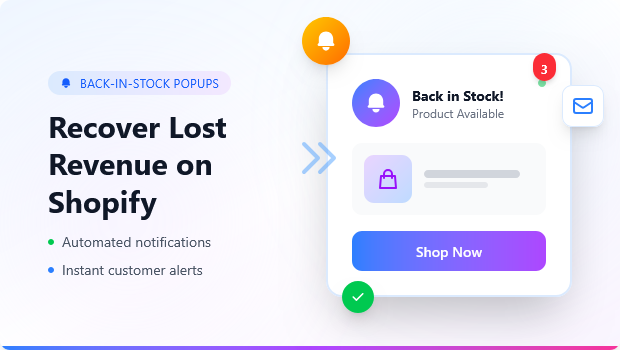
A back-in-stock popup is a conversion tool that allows customers to sign up for automated email or SMS alerts when a product returns to inventory. It helps Shopify merchants recover lost sales by capturing high-intent traffic on out-of-stock pages.
The Hidden Revenue Leak: Why Out-of-Stock Items Kill Your Shopify Conversion Rate
In the world of DTC ecommerce, momentum is everything. When a customer arrives at your product page, they are at the peak of their buying intent. A “Sold Out” button acts as a hard stop, creating friction that often sends the user directly to a competitor’s site.
This “revenue leak” is more than just a missed transaction. It impacts your store’s health in three specific ways:
- Increased CAC (Customer Acquisition Cost): You’ve already paid for the click. If that visitor leaves without providing an email or making a purchase, your marketing ROI plummets.
- Damaged Brand Trust: Repeatedly seeing out-of-stock items without a way to follow up makes your brand look unorganized or unreliable.
- Inaccurate Demand Forecasting: Without a waitlist, you have no data on how many people would have bought the item, making it nearly impossible to know how much stock to order for the next restock.
From “Sold Out” to “Sold”: How Shopify Back-in-Stock Alerts Automate Recovery
Back-in-stock alerts function as a bridge between supply chain delays and customer satisfaction. Instead of a static “Out of Stock” label, a dynamic popup appears (or a button is replaced) inviting the user to “Notify Me When Available.”
When the inventory level in your Shopify admin changes from 0 to 1 (or your preferred threshold), the system automatically triggers a notification.
For Shopify merchants, tools like GroPulse make this process seamless by integrating directly with your theme’s “Add to Cart” logic. By automating the “Notify Me” flow, you ensure that no customer is left in the dark, and you don’t have to spend hours manually emailing waitlists.
The Friction Problem: Why Customers Leave (And How to Stop Them)
The reason back-in-stock popups work is that they address the psychology of the “frustrated buyer.” A customer who wants your product but can’t have it feels a sense of scarcity.
However, if your notification signup process is too complex, they will still leave. To minimize friction:
- Single Field Signups: Only ask for an email address or phone number. Don’t ask for their name, birthday, or interests at this stage.
- Clear Value Proposition: Don’t just say “Subscribe.” Use “Be the first to know when we restock” or “Get an exclusive alert.”
- Mobile-First Design: Since over 70% of Shopify traffic typically comes from mobile devices, your popup must be unobtrusive and easy to close on a small screen.
Building Your Waitlist: A Step-by-Step Workflow to Notify Customers Automatically
Implementing this isn’t just about the popup; it’s about the backend automation. Here is the standard workflow for high-growth Shopify stores:
- Detection: The app detects the product is out of stock via the Shopify API.
- Display: The “Add to Cart” button is automatically hidden, and a “Notify Me” button or popup is rendered.
- Data Capture: The user enters their contact info. This is synced to your email service provider (like Klaviyo or Mailchimp).
- Inventory Monitoring: The app watches your Shopify inventory levels in real-time.
- The Trigger: As soon as you update stock, the app sends a personalized alert containing a direct link to the product.
Recommended Blogs for You:
👉 Personalized Popups: 5 Strategies to Target Customer Segments
👉 Best Conversion Tracking Apps for New Shopify Store Owners
👉 What Metrics Should I Track in My Google Ads Performance Reports?
👉 The Ultimate Guide to How Top Companies Maximize Revenue
Best Practices for High-Converting Notification Popups
If you want to maximize the conversion rate of your back-in-stock emails, you need to think beyond the “Restocked” subject line.
- Offer “Early Access”: Tell your waitlist they have 2 hours to shop before the restock is announced on social media. This creates a powerful “VIP” feeling.
- Use SMS for High-Demand Items: Email open rates hover around 20%, but SMS open rates are often quoted at 98%. For limited-drop items, SMS is the most effective way to ensure the stock is cleared immediately.
- Segment Your List: If you have 500 people waiting for a product but only 50 units arriving, consider only notifying the first 100 people on the list to avoid “Sold Out” frustration again.
Using a comprehensive toolkit like SalesPulse ‑ Sales Pop Up allows you to manage these varied notification types while also leveraging sales popups to show other visitors that your products are in high demand, further driving that “fear of missing out” (FOMO).

Common Shopify Mistakes That Make Your Inventory Gaps Worse
Even with the best tools, some strategic errors can hinder your recovery efforts:
- Not Setting Minimum Stock Thresholds: If you only have 2 units left, you might not want to notify 1,000 people. Set your notifications to trigger only when stock levels reach a meaningful number.
- Generic Messaging: A “back in stock” email that doesn’t include the product image or name is easily ignored.
- Ignoring the “Coming Soon” Angle: For new product launches, use the same “Notify Me” logic to build hype before the item ever goes on sale.
Optimizing Your Storefront for Demand Gains
Implementing back-in-stock alerts is a “set it and forget it” strategy that pays dividends every time you restock. To get started:
- Audit your current “Sold Out” pages. See what a visitor currently experiences.
- Choose a Shopify-native app. Look for tools that won’t slow down your site (check for “defer” loading and minimal script impact).
- Draft your recovery emails. Make them short, urgent, and brand-consistent.
By moving away from a passive “Out of Stock” approach, you turn inventory hurdles into an automated sales machine.
Frequently Asked Questions
Do back-in-stock popups hurt my SEO?
No. As long as the popup is triggered by a user action (like clicking a “Notify Me” button) or is designed to meet Google’s interstitial guidelines (not covering the main content immediately upon entry), it will not impact your search rankings.
Can I use back-in-stock alerts for SMS marketing?
Yes. In fact, SMS alerts often have a much higher conversion rate than email for restocks because of the immediacy of the notification.
Is it better to use a popup or an embedded form?
An embedded form (replacing the ‘Add to Cart’ button) usually feels more native and professional, while a popup is more effective at grabbing attention if the user is about to leave the page.