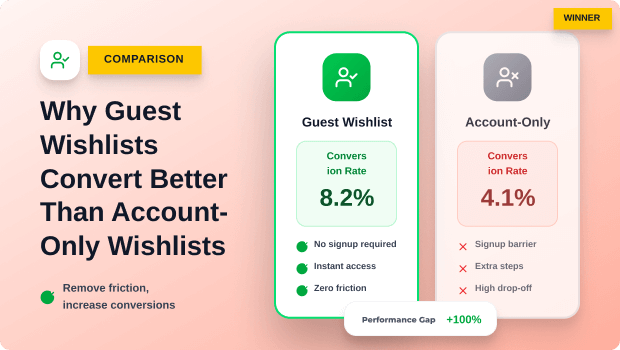
Account-only wishlists introduce immediate, unnecessary friction at the moment of high product intent (“Save for Later”), leading to abandonment.
Guest wishlists, powered by local storage (cookies), capture intent first and defer the account/email request until the point of checkout or recovery, resulting in significantly higher product saves, lower friction, and a powerful email lead generation channel.
Why Guest wishlists convert better thank account-only wishlists because they remove the account creation barrier (friction) during product discovery.
By leveraging a user’s local browser storage to save items anonymously, they capture 100% of intent, allowing merchants to later convert that saved list into a crucial email lead or a direct sale with minimal effort.
Key Takeaways
- Friction is the Enemy: Requiring account creation at the discovery stage kills conversion rates by 50% or more.
- Technical Advantage: Guest wishlists use Local Storage or Cookies to save items, creating a seamless, zero-friction experience.
- Email is the Goal: Guest wishlists are the best opportunity to turn anonymous product intent into a high-value, retargetable email lead.
- CLV Focus: Reducing initial friction increases the chances of a first purchase, which is the gateway to a higher Customer Lifetime Value (CLV).
Defining the Wishlist Friction Problem
As an SEO strategist working with hundreds of high-growth DTC brands, I’ve seen countless A/B tests on conversion rate optimization (CRO). And one finding is so consistent it feels criminal to ignore: The friction of required account creation is the single biggest conversion killer for wishlists.
Think about the user journey: They find a product they love but aren’t ready to buy today. They see a “Save to Wishlist” button. Their intent is simple: save it for later. But when they click it, they’re met with a pop-up: “Log in or Create an Account.”
The moment that barrier appears, their simple intent is blocked. Many users—especially first-time visitors—will simply abandon the action, resulting in lost intent, lost data, and a lost sale.
The Root Problem: The Account Creation Barrier
The belief that you must force an account to utilize a wishlist is based on outdated e-commerce dogma. The goal of a wishlist is not to get an account; the goal is to capture product intent for future conversion.
Most e-commerce platforms, including standard Shopify installations, default to an account-only wishlist system because it’s technically simpler to manage a list tied to a database record (User ID). But this simplicity comes at an enormous cost:
- The Trust Deficit: A first-time shopper is not ready to commit their email, password, and personal data to your store yet.
- The Cognitive Load: Creating an account takes time (entering email, password, confirming, maybe solving a CAPTCHA). It stops the shopping flow dead.
- The Data Paradox: You are sacrificing the capture of 100% of intent just to get 10% of users to complete a registration form.
Recommended Blogs for You:
👉 Wishlist vs Cart on Shopify: Which Converts Better
👉 How to Add a Wishlist Button to Your Shopify Store Complete Guide
👉 Wishlist Marketing Strategies for Shopify: Drive Sales and Customer Loyalty
Why Guest Wishlists Convert Better Than Account-Only Wishlists
Guest wishlists, often called “anonymous” or “cookie-based” wishlists, flip the script. They prioritize the user experience first and delay the required commitment.
1. Technical Advantage: Local Storage/Cookies
Instead of immediately hitting your server’s database, a guest wishlist uses the user’s browser storage:
| Storage Type | Account-Only Wishlist | Guest Wishlist |
| Data Storage | Server-side Database (tied to User ID) | Browser’s Local Storage or a Cookie |
| Required Action | Log In / Create Account | None, item saves instantly |
| Data Persistence | Permanent, across all devices | Tied to the specific browser/device (until cleared) |
| Friction Level | High | Zero |
When a user clicks ‘Save,’ the item ID is instantly written to their browser. The perceived friction is zero, capturing maximum intent.
2. The Conversion Tipping Point: Email Capture
This is the most critical conversion advantage. Once the user has saved a few items, they have high-value, personal data tied to that local storage. The system can then present a soft conversion prompt when the user leaves the site or returns later:
“Hey! It looks like you have 5 items saved on this device. Want to save them forever and get a price drop alert? Just enter your email below to link this list!”
At this stage, the user is highly motivated. They don’t have to create a full account—they just need to provide an email to secure their saved list. You convert a high-intent, anonymous shopper into a valuable email lead, ready for a highly personalized wishlist recovery email flow (a subset of abandoned cart campaigns).
Complete Solution
Implementing a high-converting guest wishlist requires a shift in technical setup and strategy, and the right app makes all the difference. GP Wishlist & Upsell is engineered precisely to leverage the power of anonymous, zero-friction intent capture.
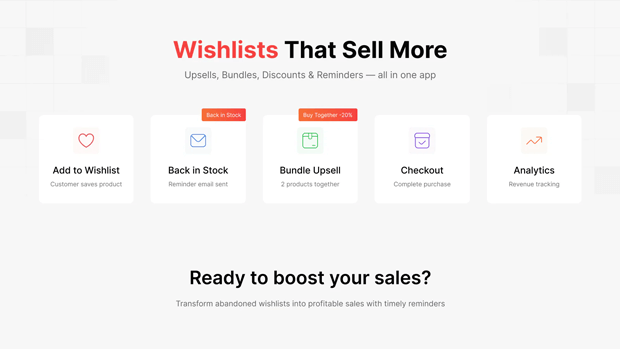
First, install the app from the Shopify App Store. GroPulse is natively designed for the Guest Wishlist approach, using secure local storage by default.
👉 Follow the documentation to configure the app properly: https://gropulse.com/docs-category/wishlist/
Tools / Features Required
- A dedicated Shopify Wishlist App (e.g., Wishlist Plus, Growave) that supports Local Storage/Guest Wishlists.
- Integration with a robust ESP like Klaviyo or Mailchimp for automated flow setup.
- Shopify Flow (for Plus merchants) to trigger custom events based on wishlist activity.
Risks, Pitfalls & Edge Cases
- Browser/Cookie Deletion: If a user clears their browser cache or cookies, the list saved via local storage will be lost. Mitigation: This is why the soft email capture (Step 3) is so crucial; it moves the data from temporary storage to your permanent database.
- Device Switching: Guest wishlists don’t transfer across devices unless the user converts to an email/account. Mitigation: Communicate this clearly (“Your list is saved on this device! Link your email to access it anywhere.”).
- Performance Hit: A poorly coded app might put a large payload into Local Storage, slowing down the site. Mitigation: Ensure your app uses efficient code and only stores necessary product IDs.
What to Learn Next
After implementing your guest wishlist, your next step is to master the abandoned wishlist email sequence to maximize the ROI of those captured leads.
Frequently Asked Questions
Is it better to have a wishlist for guests or require an account?
It is always better for conversion to offer a guest wishlist first. Requiring an account creates high friction, leading to significant abandonment. Capture the product intent instantly via local storage and then ask for an email to save the list permanently.
How do guest wishlists work technically?
Guest wishlists save product IDs directly to the user’s browser using Local Storage or Cookies instead of requiring a server-side database lookup linked to a user ID. This allows the item to be instantly saved without a login, resulting in a seamless, zero-friction experience.
Does a guest wishlist hurt my customer data collection?
No. While the initial save is anonymous, a guest wishlist creates a powerful, high-intent lead generation opportunity. You are capturing customers who would have otherwise left, and you can offer them the option to convert their saved list into an email lead, often at a higher rate than a generic pop-up.
How do I stop the wishlist from disappearing when the user closes the browser?
If using Local Storage (preferred), the list should persist even after the browser is closed, typically until the user manually clears their cache. However, to make it permanent across devices and browsing sessions, you must prompt the user to link an email to the list.
Conclusion
The difference between an account-only wishlist and a guest-friendly one is a fundamental shift from prioritizing your database requirements to prioritizing the user experience. In today’s competitive e-commerce landscape, friction is your biggest enemy.
By leveraging the technical simplicity of local storage, the psychological power of delayed commitment, and the conversion strength of email capture, a guest wishlist strategy will turn more anonymous browsers into high-intent leads and, ultimately, high-value, repeat customers.