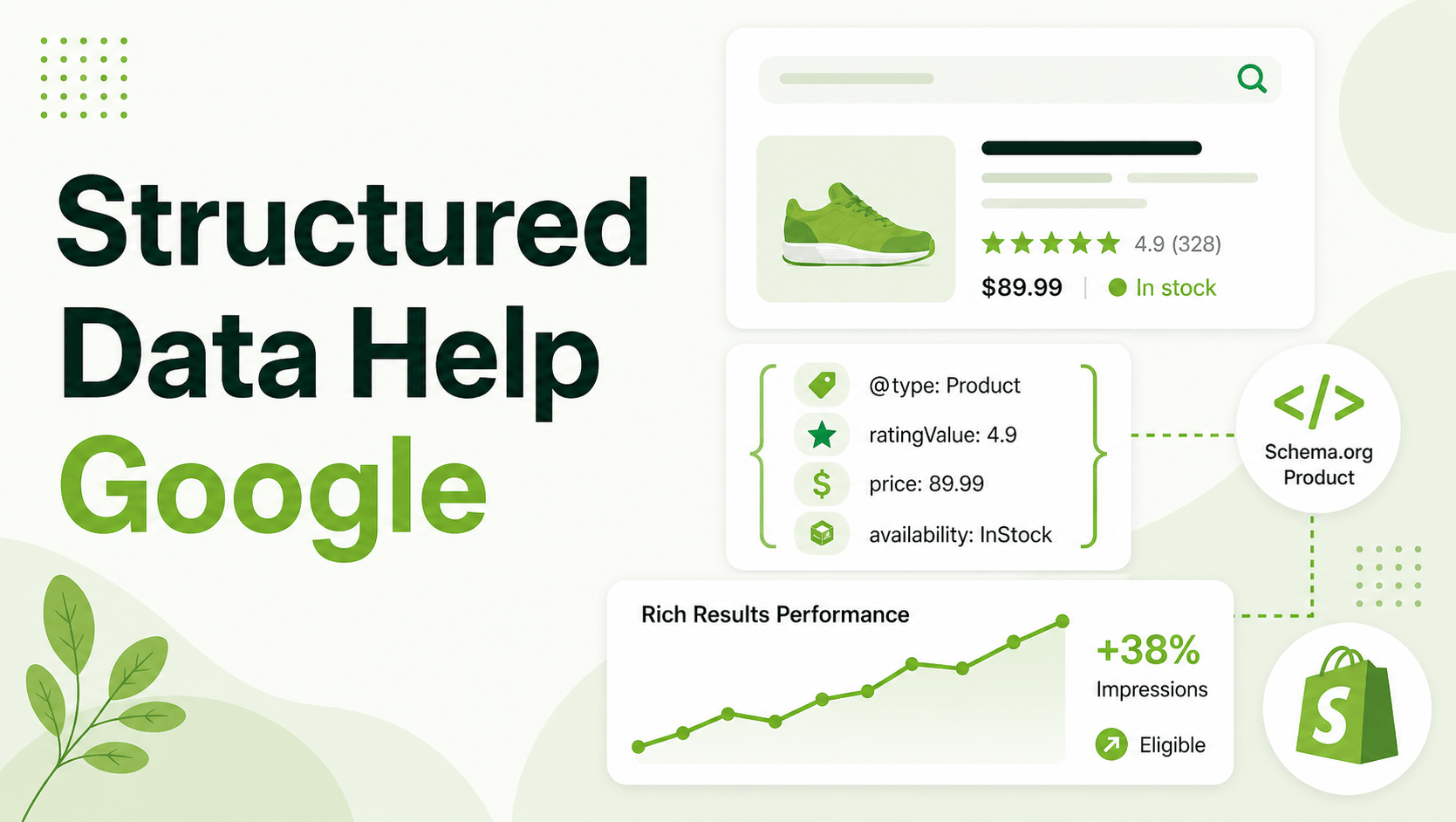
Structured data helps Google interpret your Shopify store by clearly defining products, pricing, reviews, and page relationships. This improves how your store appears in search results and increases the likelihood of earning rich snippets.
When combined with strong market signals like demand and pricing consistency, structured data can significantly improve both visibility and click-through rates.
Structured data (JSON-LD) acts as a machine-readable translator for Shopify stores, allowing Google to identify specific elements like price, availability, and star ratings. By implementing schema markup through tools like GP JSON-LD Schema, merchants can transform plain search listings into Rich Snippets, which are proven to increase click-through rates (CTR) by up to 58%.
Why Does Google Need Structured Data to Understand Your Store?
Google relies on structured data to interpret what your pages represent, not just what they say. Without it, your store appears as unstructured content, making it harder for search engines to extract meaning and display enhanced results.
Most Shopify stores rely on:
- Page titles
- Descriptions
- Basic metadata
But that’s not enough.
Structured data, like JSON-LD, explicitly tells Google:
- What your product is
- How much it costs
- Whether it’s in stock
- How customers rate it
This is what enables rich results such as:
- Star ratings
- Price displays
- Availability indicators
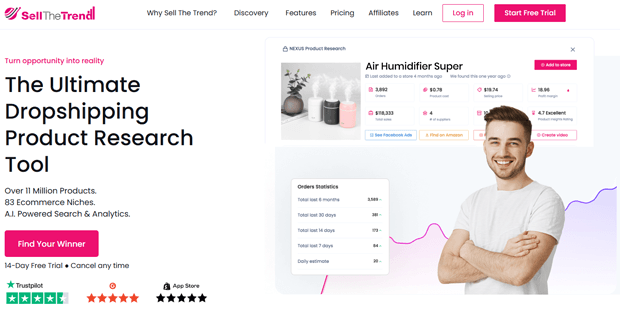
AI product discovery platforms like Sell The Trend show that products with consistent pricing, stable demand, and clear positioning create stronger signals, making it easier for search engines to understand and confidently display them in search results.
What Is JSON-LD and Why Is It Important for Shopify SEO?
JSON-LD is a structured data format that allows you to communicate key information about your store directly to search engines in a machine-readable way.
Instead of guessing what your content means, Google can read it clearly.
For Shopify stores, JSON-LD typically includes:
- Product schema
- Organization schema
- Breadcrumb schema
- FAQ schema
- Review schema
Platforms like Google Search Console use this structured data to:
- Validate your pages
- Surface rich results
- Monitor performance
Without JSON-LD:
- Your listings appear plain
- Your competitors stand out more
- Your click-through rates suffer
With JSON-LD:
- Your listings become more informative
- Your store gains visual advantages in search
- Your SEO performance improves over time
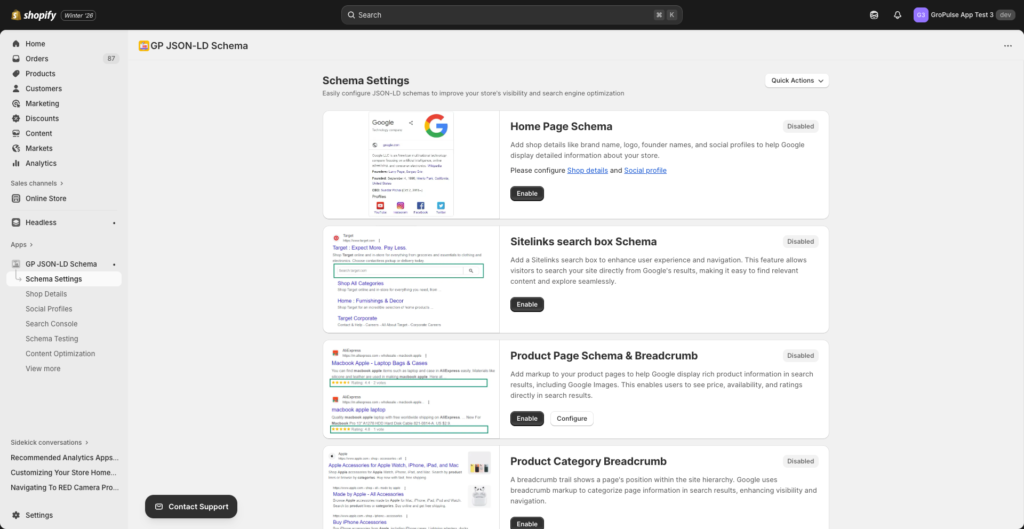
While JSON-LD refers to the structured data format itself, many Shopify merchants use apps like GP JSON-LD to implement it without coding. These tools automatically generate and maintain schema across product pages, collections, and site structure, making it easier to apply structured data consistently at scale.
How Do High-Performing Shopify Stores Use Structured Data Differently?
High-performing stores combine structured data with strong market signals like pricing consistency, demand, and product positioning to create listings that both rank and convert.
Structured data alone doesn’t create demand.
It amplifies it.
Top-performing stores typically show:
- Clear pricing aligned with market expectations
- Consistent product demand across regions
- Active engagement signals
Key signals observed:
- Stable pricing vs erratic discounting
- Ongoing order activity
- Product relevance within a niche
Patterns:
- Products with consistent demand outperform short-lived spikes
- Structured listings convert better when backed by real demand
- Clear product positioning improves both ranking and CTR
Seller actions:
- Align product pricing with market expectations
- Validate demand before optimizing listings
- Avoid saturated products with declining signals
This is where many sellers evolve beyond early tools like AutoDS or Spocket that focus mainly on sourcing.
More advanced workflows rely on combining structured SEO with real market intelligence to improve outcomes.
Recommended Blogs for You:
👉 Shopify Local Business Schema
👉 Google AI Overviews vs Traditional SEO
👉 Artificial Engine Optimization (AEO) for Shopify
How Do Rich Snippets Impact Click-Through Rates and Rankings?
Rich snippets increase click-through rates by making your listings more visible and informative, which can indirectly improve rankings over time.
When users see:
- Star ratings
- Prices
- Stock availability
they are more likely to click.
Typical outcomes include:
| Listing Type | Expected Performance |
| Plain listing | Lower CTR |
| Rich snippet listing | Higher CTR and engagement |
Data shows:
- Up to 58% higher click-through rates with rich snippets
- Up to 35% increase in organic traffic over time
But here’s the key insight:
Rich snippets don’t create demand.
They amplify existing demand signals.
Pro Tip: Only optimize listings with structured data after validating product demand. Otherwise, you’re improving visibility for products that won’t convert.
What Role Does Competitor Data Play in Structured SEO?
Competitor data reveals how top stores structure their listings, price products, and maintain visibility, giving you a blueprint for optimization.
Google evaluates:
- Product relevance
- Pricing competitiveness
- Engagement signals
- Content clarity
High-performing stores tend to align across all of these.
Signals to analyze:
- Estimated monthly revenue
- Top-selling products
- Pricing trends
- Active ads
- Traffic patterns
Patterns observed:
- Stores with consistent pricing and active demand rank more reliably
- Listings backed by strong engagement outperform static ones
- Structured data enhances already successful products
Seller actions:
- Study top competitors in your niche
- Identify pricing and positioning strategies
- Apply structured data to validated products
This approach transforms competitor research into actionable SEO improvements.
Many sellers reference structured store data to guide these decisions, using tools that surface real competitor performance, such as store intelligence insights across Shopify stores.
How Does JSON-LD Fit Into a Modern Shopify SEO Stack?
JSON-LD acts as the execution layer that translates your store’s data into a format search engines can understand and use effectively.
Tools like GP JSON‑LD Schema & AI SEO simplify this process by:
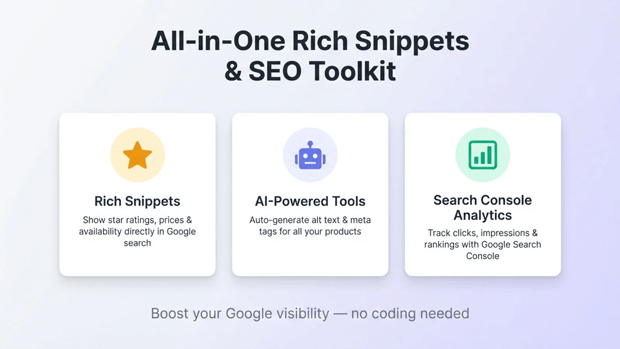
- Automatically adding structured schema
- Enabling rich snippets
- Keeping data updated in real time
Instead of manually coding schema, store owners can:
- Deploy structured data in minutes
- Maintain accuracy as products change
- Ensure compliance with search engine standards
This becomes especially powerful when combined with validated product and market insights.
For example, many sellers reference validated product data to decide what to optimize, such as in this curated list of trending products:
https://www.sellthetrend.com/trending-products
This ensures that:
- The right products get visibility
- Structured data supports real demand
- SEO efforts produce measurable results
What Happens When You Combine Market Intelligence With Structured Data?
Combining market intelligence with structured data creates a system where validated demand is amplified through better visibility and higher conversion rates.
Here’s how the layers work together:
| Layer | Function |
| Market Intelligence | Identifies what products will sell |
| Structured Data (JSON-LD) | Makes those products visible in search |
Without validation:
- You optimize the wrong products
Without structure:
- Good products remain hidden
Together:
- You improve both ranking and performance
Pro Tip: Focus on products with stable demand signals before investing in structured SEO. This creates a compounding effect over time.
Frequently Asked Questions
Does structured data directly improve rankings?
Not directly. But it improves click-through rates and helps search engines understand your content, which can positively impact rankings over time.
Can I add JSON-LD without coding?
Yes. Many Shopify apps automate the process, allowing you to add structured data in minutes without technical knowledge.
Do rich snippets work for all products?
They work best for products with reviews, pricing clarity, and active demand signals.
How long does it take to see results?
Rich snippets can appear within days, but SEO performance improvements typically take a few weeks to months.
Is structured data enough for SEO success?
No. It must be combined with strong product selection, pricing strategy, and demand validation.
Final Takeaway
Structured data doesn’t replace SEO. It upgrades it.
When your products are validated through real market signals and clearly structured for search engines, your store becomes easier to understand, easier to rank, and easier to click.
That’s how modern Shopify stores move from being indexed… to being chosen.