When you launch your first five products on Shopify, writing a unique meta title and description for each feels manageable. You carefully craft every word to ensure it fits within Google’s character limits. But as your store grows to 50, 500, or 5,000 SKUs, that manual process doesn’t just slow down—it breaks.
Most merchants eventually default to one of two “growth killers”: they either leave the meta description blank (letting Google scrape random page text) or they use a rigid, robotic template that fails to entice shoppers. Neither approach helps you rank, and both hurt your brand’s perceived authority in the SERPs (Search Engine Results Pages).
In the current ecommerce landscape, where organic reach is increasingly competitive, the ability to generate high-quality, keyword-rich metadata at scale is no longer a luxury; it is a fundamental requirement for maintaining a healthy conversion funnel.
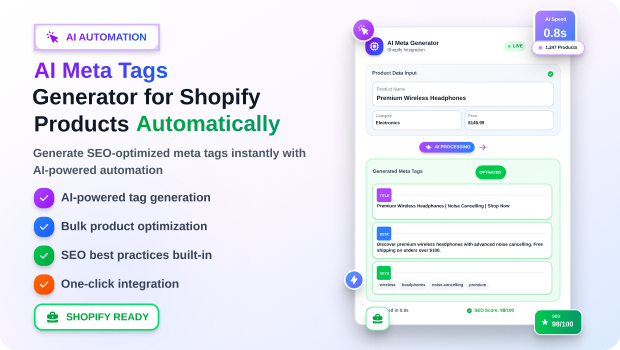
An AI meta tags generator for Shopify uses machine learning to analyze product descriptions and automatically produce optimized meta titles and descriptions. Tools like GP JSON-LD Schema enable merchants to audit SEO scores and apply AI-generated recommendations to thousands of products simultaneously.
Summary
- The Problem: Manual metadata entry becomes a growth bottleneck as Shopify catalogs scale.
- The Solution: AI-powered generators analyze product data to create high-CTR titles and descriptions in seconds.
- Key Benefit: Improves search visibility and click-through rates (CTR) while maintaining consistent SEO standards.
- What You’ll Learn: A step-by-step workflow to automate your metadata using AI tools integrated with Shopify.
What Problem Are Shopify Merchants Actually Facing with Meta Tags?
The core issue isn’t just “writing.” It’s the technical precision required for search engines to reward your pages. Shopify merchants frequently struggle with three specific pain points:
- The “Missing Meta Description” Trap: Shopify often defaults to using the first few lines of a product description for the meta tag. If your description starts with “Features include…” or “Free shipping on orders over $50,” your search snippet looks unprofessional and fails to communicate the product’s value.
- Character Count Anxiety: Google typically truncates titles at ~60 characters and descriptions at ~155. Writing “just enough” content that is also persuasive is a specialized skill that most store owners don’t have time to master.
- Audit Fatigue: Finding which of your 200 collections or 1,000 products needs an update is a manual nightmare. Without a dashboard to highlight “SEO warnings,” critical errors stay hidden for months.
How Optimized Meta Titles and Descriptions Drive Shopify Revenue
According to a comprehensive study by Backlinko, the #1 organic result in Google has an average click-through rate (CTR) of 27.6%. However, ranking is only half the battle.
If your meta tags aren’t compelling, users will skip your result for a lower-ranking competitor with a better “sales pitch” in their snippet.
Optimized meta tags act as your “organic ad copy.” By using an AI generator to include relevant keywords and clear calls to action (CTAs), you improve the relevance of your snippet.
High CTR sends positive signals to Google’s algorithm, which can lead to higher rankings over time, creating a “flywheel” effect for your organic traffic and, ultimately, your Average Order Value (AOV).
Recommended Blogs for You:
👉 Top 10 Schema Types Every Shopify Store Should Use for Better SEO
👉 The Role of Schema Markup in EEAT and Semantic SEO
👉 Schema Markup for Shopify: Complete Implementation
👉 Shopify Product Page SEO: The Ultimate 2025 Optimization Guide
Why Manual Meta Tag Entry Stalls Growth (Root Causes Explained)
The “human element” is the biggest variable in SEO inconsistency. When different team members, or even the same person at different times, write metadata, the tone of voice shifts.
One product might have a punchy, benefit-driven title, while another is just a string of keywords.
Furthermore, manual entry ignores data-driven insights. An AI Meta Tags Generator for Shopify doesn’t just “write”; it analyzes the existing product content and matches it against SEO best practices.
It removes the guesswork and ensures that every single page on your site meets a minimum “quality floor” before it ever hits Google’s index.
Best AI Meta Tags Generator for Shopify Products
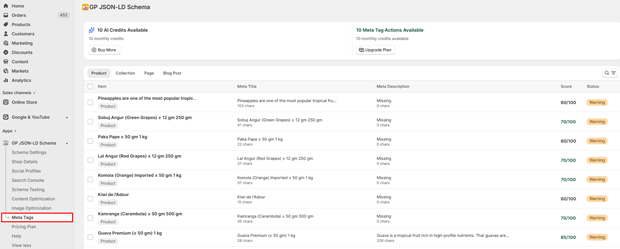
To move away from manual entry, you need a system that identifies weaknesses and provides instant fixes. Here is the professional workflow for automating your metadata:
- Identify the Gaps: Use a tool that scans your entire Shopify store (Products, Collections, Pages, and Blog Posts) to find items with “Missing” or “Suboptimal” meta tags.
- Filter by Priority: Focus on “Needs optimization” or “Warning” statuses first. These are usually pages where the title is too short or the description is missing entirely.
- Generate with AI: Instead of writing from scratch, trigger an AI suggestion. The AI should look at your product title and description to suggest a meta tag that includes your primary keywords while staying within character limits.
- Bulk Apply and Sync: Once satisfied with the suggestions, apply the changes. A professional integration will sync these directly to your Shopify Admin so you don’t have to copy-paste.
For merchants looking to streamline this, the GP JSON-LD Schema for SEO app provides a dedicated Meta Tags Optimization dashboard.
It categorizes your content by type and uses AI-powered recommendations to generate titles and descriptions.
Depending on your scale, the app offers different tiers: the Free plan includes 10 actions per month, while the Advanced plan provides unlimited actions for stores with massive catalogs.
Common Shopify Mistakes That Hurt Your Meta Tag Performance
Even with AI help, merchants often fall into these common traps:
- Keyword Stuffing: Thinking that repeating “Blue Suede Shoes” five times in a description will help. It doesn’t; it lowers CTR because it looks like spam to users.
- Ignoring the “SEO Visibility” Status: Many merchants forget to check if a product is even “Visible” to search engines in their Shopify settings.
- Static Metadata: SEO isn’t “set it and forget it.” If a product’s search performance is declining in Google Search Console, it’s time to run a new AI analysis and refresh the tags.
What To Do Next in Your Shopify Optimization Journey
Automating your meta tags is the first step in a broader SEO strategy. Once your snippets are optimized for clicks, you must ensure the search engines can actually “read” the data on your page.
- Integrate Search Console: Monitor which pages have high impressions but low clicks. These are your prime candidates for meta tag optimization.
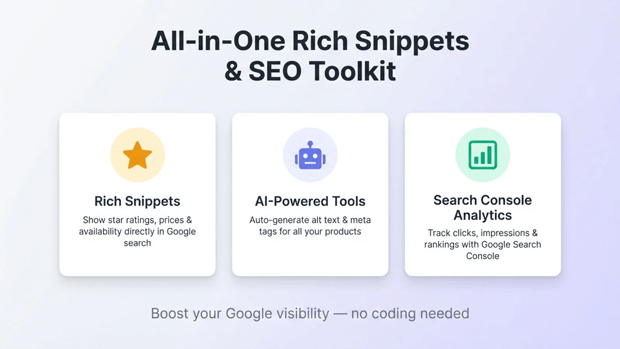
- Verify your Schema: Meta tags help users, but JSON-LD Schema helps bots. Ensure your automated meta tags are supported by valid Product Schema so you can earn “Rich Snippets” (like star ratings and price displays).
- Audit Images: Don’t forget that Google Image Search is a massive traffic driver. Ensure your image alt text is as optimized as your meta titles.
Frequently Asked Questions
Do I need to manually save AI-generated meta tags to Shopify?
If you use the GP JSON-LD Schema app, you can apply AI-generated suggestions directly within the app’s dashboard. These changes are then synced to your Shopify store, eliminating the need for manual copy-pasting.
How long does it take for meta tag changes to show in Google?
Typically, it takes 1 to 4 weeks for Google to re-crawl your site and update the search snippets. You can speed up this process by requesting re-indexing through the URL Inspection tool in Google Search Console.
Will AI-generated meta tags help me rank #1?
While meta tags are a critical ranking factor and significantly impact Click-Through Rate (CTR), they are part of a larger SEO ecosystem that includes site speed, backlink profile, and high-quality structured data (Schema).
Conclusion
In an era where AI is redefining how we create content, continuing to write meta tags manually is a waste of a merchant’s most valuable resource: time. By implementing an AI Meta Tags Generator for Shopify, you ensure your store remains professional, searchable, and—most importantly—scalable.