After checkout, most Shopify teams track revenue and ad performance, but skip structured customer feedback. That creates a blind spot: you can see what customers bought, but not how they felt about the buying and fulfillment experience.
This guide shows how to run NPS and CSAT for Shopify stores with practical questions, timing, segmentation, and reporting. It also explains where Shopify’s current checkout and post-purchase architecture matters so your measurement setup stays stable.
Quick Answer
Use CSAT right after key moments (delivery, support, returns) and NPS periodically for loyalty. In Shopify, collect responses via post-purchase pages, customer accounts, email/SMS, and feed results into a simple segment-based dashboard.
Summary
NPS measures loyalty trend over time. CSAT measures satisfaction at specific touchpoints. For Shopify, run both: CSAT for operational fixes, NPS for retention strategy. Use consistent question wording, segment results, and close the loop with clear follow-up actions.
Shopify NPS and CSAT: Metrics, Questions, and Setup Guide
Shopify NPS vs CSAT: what each metric tells you
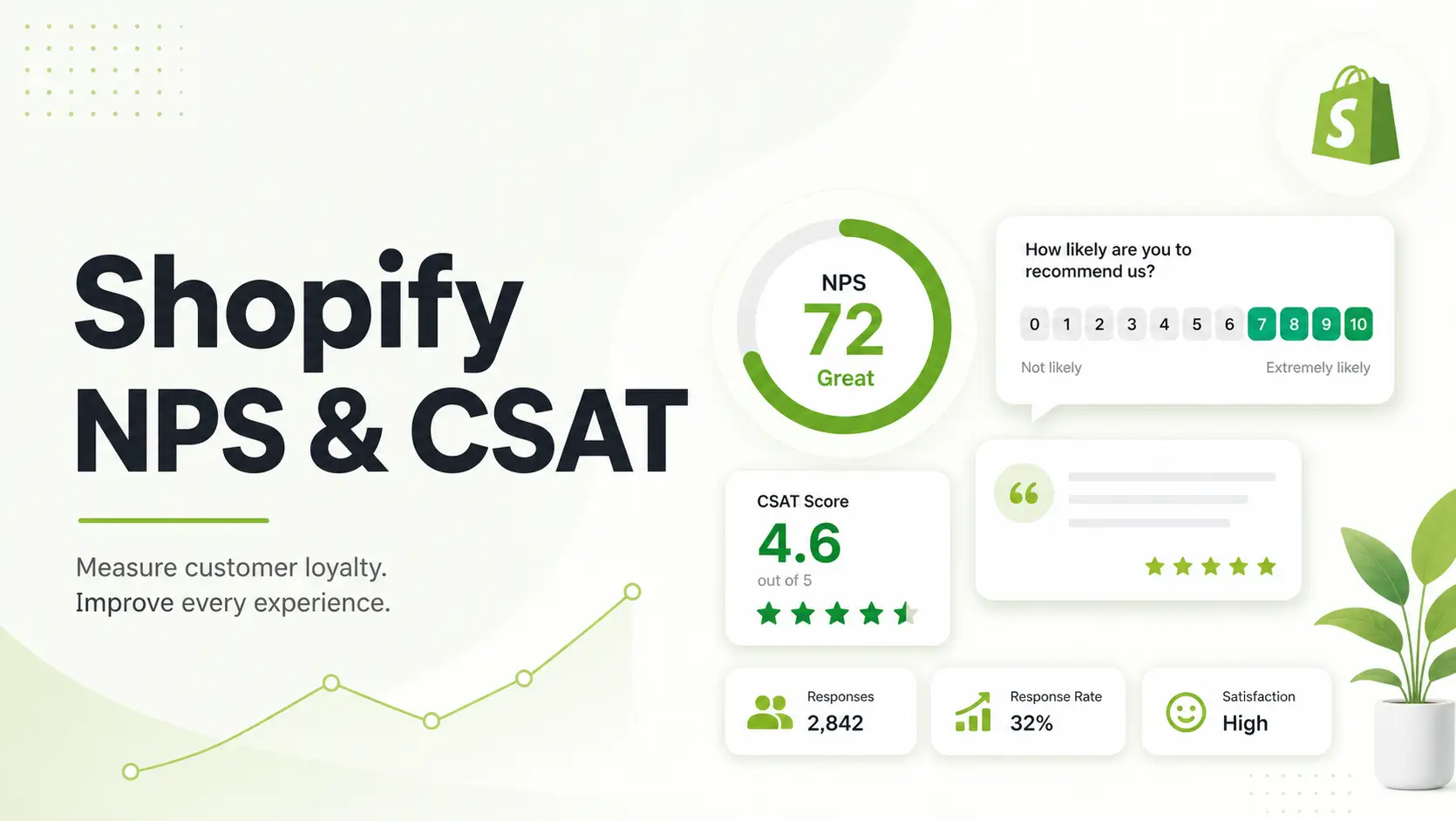
NPS (Net Promoter Score) asks: “How likely are you to recommend us?” on a 0–10 scale. Promoters are 9–10, passives 7–8, detractors 0–6, and score = %promoters − %detractors.
CSAT (Customer Satisfaction Score) asks a touchpoint-specific satisfaction question, usually on a 1–5 scale. Teams commonly track the percentage of top ratings (for example, 4–5 out of 5).
Use NPS to understand long-term loyalty direction. Use CSAT to diagnose concrete workflow issues such as shipping communication, return flow, or support resolution.
| Metric | Best use in Shopify | Best timing | Main output |
|---|---|---|---|
| NPS | Loyalty trend and retention risk | 30–45 days post-delivery or quarterly | Promoter/detractor movement by segment |
| CSAT | Touchpoint quality monitoring | Immediately after event (support, return, delivery) | Operational issue detection and prioritization |
Shopify survey questions that produce usable data
Keep questions short and singular. Avoid combining multiple ideas in one prompt.
- Core NPS question: “How likely are you to recommend our store to a friend or colleague?” (0–10)
- NPS follow-up: “What is the main reason for your score?”
- Delivery CSAT: “How satisfied are you with your delivery experience?” (1–5)
- Product expectation CSAT: “How satisfied are you with how the product matched expectations?” (1–5)
- Support CSAT: “How satisfied are you with how your issue was resolved?” (1–5)
- Returns CSAT: “How satisfied are you with the return or exchange process?” (1–5)
If you use both metrics, keep scales consistent per metric and avoid changing wording every month. Trend quality depends on consistency.
Shopify setup: where to collect NPS and CSAT responses
For most stores, the best collection stack is multi-surface:
- Thank-you / order status moments: good for immediate CSAT prompts.
- Customer account surfaces: useful for follow-up prompts and context-rich feedback.
- Email or SMS: best for delayed NPS (after first product use or post-delivery window).
- On-site account area: useful for periodic NPS pulses for repeat buyers.
Shopify’s modern checkout and customer events model favors app blocks, UI extensions, and pixels over legacy script-based methods. That matters because legacy thank-you/order-status customizations were deprecated and then auto-upgraded on Shopify timelines, so durable implementations should align with current extensibility patterns.
Recommended Blogs for You:
👉 Post-Purchase Surveys for Shopify
👉 How to Generate Professional Shopify Credit Notes
👉 The Lifecycle of a Shopify Bundle
Shopify workflow: a practical 7-step implementation
- Pick one primary business goal for the quarter (repeat purchase, fewer returns, better support outcomes).
- Map 2–3 customer touchpoints where feedback is most useful.
- Assign NPS to loyalty checkpoints and CSAT to operational checkpoints.
- Define audience segments (new vs repeat, domestic vs international, subscription vs one-time).
- Set automation cadence (triggered CSAT, scheduled NPS).
- Build a simple dashboard with trend lines and comment tagging.
- Create a weekly close-the-loop process with owner names and deadlines.
Shopify dashboard design: what to track weekly
- NPS overall and by segment
- CSAT by touchpoint (delivery, support, returns, product expectation)
- Response rate by channel
- Top 5 negative themes from comments
- Action backlog and completion rate
- Recovery outcomes for detractors
Shopify manual setup vs app-based setup
| Approach | Good fit | Tradeoff |
|---|---|---|
| Manual setup (forms + exports + spreadsheets) | Small catalogs, low order volume, early-stage teams | Flexible but time-heavy and error-prone at scale |
| App-based workflow | Growing stores needing automation and segmentation | Faster operations but requires app selection and governance |
Manual works for learning. App-based usually wins once response volume or segmentation complexity grows.
Common Shopify NPS and CSAT mistakes to avoid
- Using NPS as a daily operational alert metric
- Asking CSAT too late after the touchpoint
- Changing question wording too frequently
- Ignoring open-text comments
- Mixing pre-purchase and post-purchase feedback in one trendline
- Collecting feedback without ownership for follow-up actions
How to validate your Shopify NPS and CSAT program in 30 days
- Check if response rates are stable across at least two segments
- Confirm that top complaint themes are specific and actionable
- Verify that at least one process change was shipped from survey insights
- Measure whether detractor follow-up improves repeat purchase or support outcomes
Freequently Asked Questions
Should Shopify stores use both NPS and CSAT?
Yes. NPS tracks loyalty trend over time, while CSAT catches touchpoint-level issues. Running both gives strategy and operations coverage.
What is a good NPS survey cadence for Shopify?
For many stores, run NPS every quarter or 30–45 days post-delivery. Keep cadence consistent so trend comparisons stay meaningful.
When should I send CSAT surveys in Shopify?
Send CSAT immediately after the touchpoint: delivery confirmation, support ticket resolution, or return completion.
Can I place NPS and CSAT on Shopify thank-you or order status flows?
Yes, but use current Shopify extensibility patterns (app blocks/extensions/pixels) for durability instead of legacy script-dependent setups.
How many questions should a Shopify CSAT survey include?
Start with one core satisfaction question and one optional comment follow-up. Short surveys get higher completion rates.
How do I calculate NPS for a Shopify store?
Classify responses: promoters (9–10), passives (7–8), detractors (0–6). NPS equals % promoters minus % detractors.
How should I segment Shopify NPS and CSAT data?
Segment by new vs repeat customers, geography, product category, shipping method, and support contact history.
What should I do with detractor feedback in Shopify?
Tag themes, assign an owner, follow up quickly, and track whether process changes reduce similar detractor comments.
Is manual tracking enough for Shopify NPS and CSAT?
Manual tracking can work early on, but growing stores typically need app-based automation for consistency, scale, and faster analysis.
What’s the biggest mistake in Shopify post-purchase surveys?
Collecting responses without a close-the-loop process. Feedback only creates value when tied to clear actions and owners.
Conclusion
NPS and CSAT are strongest when combined: CSAT tells you where to fix, NPS tells you whether loyalty is improving. In Shopify, the winning setup is consistent questions, channel-aware timing, segmented analysis, and disciplined follow-through on what customers tell you.