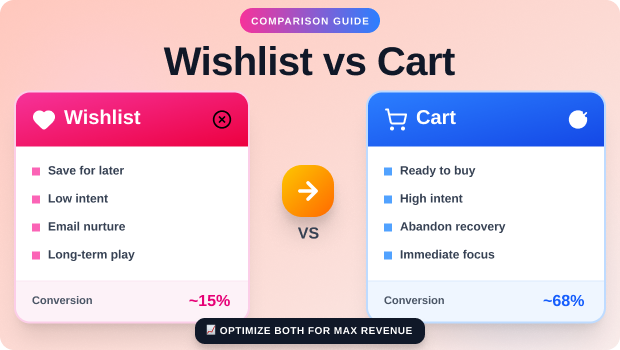
Shoppers use carts and wishlists with vastly different intents. The cart is for immediate transactional goals, while the wishlist is for aspirational planning and organization. Treating them the same in your marketing automation is a mistake.
This guide breaks down the behavioral psychology behind both and provides distinct optimization strategies to maximize revenue from every click.
The Shopping Cart represents high purchase intent and immediate needs. The Wishlist represents aspirational interest, future planning, and product comparison.
Strategies for carts should focus on removing friction and urgency, while wishlists require long-term nurturing and personalized triggers.
Key Takeaways
- Intent Gap: Carts are transactional; Wishlists are organizational and emotional.
- The “Parking Lot” Theory: Wishlists often act as a holding area for items users want but aren’t ready to finance.
- Strategy Split: Carts need friction removal (speed); Wishlists need engagement triggers (price drops, low stock).
- Data Goldmine: Wishlist data reveals future trends and inventory demand before purchases happen.
- The “Save for Later” Hack: Moving items from Cart to Wishlist can actually save a sale.
Why This Matters Now
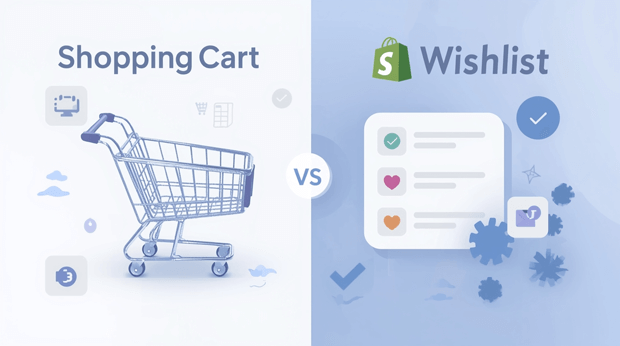
In the current e-commerce climate, Customer Acquisition Cost (CAC) is at an all-time high. Merchants can no longer afford to treat a “Wishlist Add” as a vanity metric or an “Add to Cart” as a guaranteed sale.
Many Shopify merchants make the fatal mistake of treating these two actions identically. They send the same aggressive “Buy Now” email flows for both. The result? You annoy the aspirational browser and fail to convert the high-intent buyer.
Understanding the behavioral nuance between the Wishlist and the Cart is the key to unlocking higher Customer Lifetime Value (CLV) without spending more on ads.
Wishlist vs Cart: Behavioral Differences
To optimize your store, you must first understand the mindset of the user when they click that button.
1. The Shopping Cart: High Intent, High Anxiety
When a user adds an item to the cart, they are signaling: “I am ready to buy this now, provided nothing goes wrong.”
The psychology here is transactional. The user has evaluated the product and decided it meets their needs.
- Behavior: Logical, price-conscious regarding shipping/taxes, sensitive to technical friction.
- Primary Barrier: Surprise costs, complicated checkout, forced account creation.
2. The Wishlist: Aspirational & Organizational
When a user adds an item to a wishlist, they are signaling: “I like this, but I cannot or will not buy it today.”
The psychology here is emotional or organizational. They are curating a collection or waiting for a specific event (payday, sale, holiday).
- Behavior: Browsing, collecting, waiting for triggers.
- Primary Barrier: Budget constraints, lack of urgency, waiting for validation (social or price).
Recommened Blogs for You:
👉 How to Add a Wishlist Button to Your Shopify Store Complete Guide
👉 Shopify Checkout Page Optimization for Upsells & Post-Purchase Offers
👉 Tiered Pricing Examples: The Ultimate Guide to How Top Companies Maximize Revenue
👉 Wishlist Marketing Strategies for Shopify: Drive Sales and Customer Loyalty
Data & Industry Analysis: Comparison Table
| Feature | Shopping Cart | Wishlist |
| User Intent | Transactional (Buy Now) | Aspirational (Buy Later) |
| Timeframe | Minutes to Hours | Days to Months |
| Emotional State | Decisive, Anxious | Dreamy, Organized |
| Marketing Trigger | Scarcity, Speed, Trust | Price Drops, Back in Stock, Reminders |
| Key Metric | Conversion Rate (CR) | Return Rate, Engagement |
Impact on Merchants
Misinterpreting these signals leads to two main problems:
- Lost Revenue via Spam: Sending an aggressive “Did you forget this?” email to a wishlister 1 hour after they saved an item is tone-deaf. They didn’t “forget” it; they are saving it. You risk an unsubscribe.
- Inventory Blindness: Carts show what is selling now. Wishlists show what will sell if the price is right. Ignoring wishlist data means missing out on forecasting inventory demand.
Strategies: How to Optimize Both
Here is how to turn these behavioral insights into actionable Shopify strategies.
Optimization A: The Cart (The “Closer” Strategy)
Your goal here is speed and trust.
- Reduce Friction: Ensure your checkout is seamless. Avoid forcing account creation immediately.
- Exit-Intent Offers: If a cursor moves to leave, trigger a popup offering a small discount or free shipping to close the deal now.
- Visual Scarcity: Use “Low Stock” badges in the cart drawer to push the user from consideration to action.
- The “Save for Later” Pivot: (Pro Tip) If a user attempts to remove an item from the cart, use a tool (like GP Suite) to ask, “Do you want to move this to your Wishlist instead?” This captures the lead rather than losing the user entirely.
Optimization B: The Wishlist (The “Nurture” Strategy)
Your goal here is to stay top-of-mind until the user is ready.
- Price Drop Alerts: This is the highest converting email for wishlists. Automate an email the moment a wishlisted item goes on sale.
- Low Stock Nudges: “The item in your wishlist is almost gone.” This injects artificial urgency into a low-urgency list.
- Social Proof Retargeting: Use Meta/Google ads to show users the specific items in their wishlist, paired with reviews from other customers.
- Shareable Lists: Enable users to share lists (Weddings, Birthdays). This turns one lead into a viral loop of potential new customers.
Pitfalls to Avoid
- The “Login Wall”: Do not force users to log in just to add to a wishlist. Allow “Guest Wishlists” (a core feature of GP Suite) to capture the interest first, then ask for the email later.
- Generic Emails: “Come back to our store” is weak. “The Red Dress you loved is now 20% off” is powerful.
- Ignoring Mobile: 70% of wishlisting happens on mobile during downtime (commuting, watching TV). Ensure your wishlist button is thumb-accessible and instant.
Frequently Asked Questions
What is the main difference between cart abandonment and wishlist intent?
Cart abandonment usually indicates price shock or technical friction during a purchase attempt. Wishlist additions indicate a desire to purchase later, often waiting for better pricing or financial availability.
Should I send emails to customers who add items to their wishlist?
Yes, but the tone should be different from cart recovery. Use “nurturing” emails like Price Drop Alerts, Low Stock Warnings, or generic “Your favorites are waiting” reminders rather than aggressive “Buy Now” calls to action.
Can wishlists help with inventory management?
Absolutely. Wishlist data acts as a “demand forecast.” If 1,000 people have a specific variant in their wishlist, you can confidently restock that item knowing there is pent-up demand.
How do I reduce cart abandonment using wishlists?
Allow users to “Save for Later” or “Move to Wishlist” directly from the cart drawer. This prevents a hard exit and keeps the user in your ecosystem, allowing you to retarget them later.
Do I need an app for Wishlists on Shopify?
While some themes have basic functionality, a dedicated app like GP Wishlist & Upsell Suite provides critical features like Guest Wishlists, email triggers (Price Drops), and analytics that standard themes lack.
Conclusion
The Cart is your sales floor; the Wishlist is your fitting room. Customers behave differently in each, and your strategy must adapt. By respecting the “save for later” intent and optimizing the “buy now” friction, you turn your Shopify store into a conversion machine that captures revenue at every stage of the customer journey.