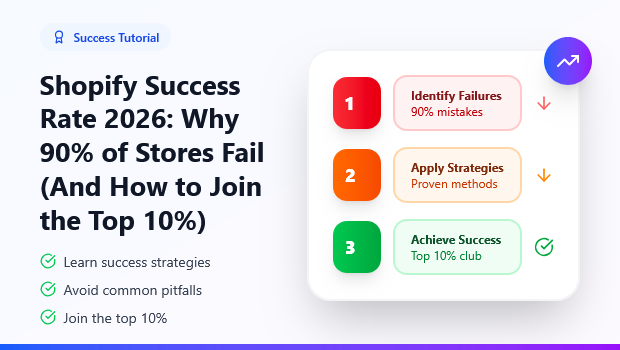
In 2026, the Shopify landscape is more crowded than ever, with over 2.8 million active stores competing for a global audience that is increasingly wary of generic dropshipping sites.
While the platform has facilitated over $1 trillion in cumulative sales, the reality for new entrepreneurs is sobering: industry data suggests that between 80% and 90% of Shopify stores fail within their first year.
The difference between those who lose money on ads and those who build multi-million dollar brands isn’t just about having a “winning product”—it’s about the systems behind the storefront.
Top-tier merchants are moving away from “aesthetic-only” design and embracing a data-first approach that prioritizes high-accuracy tracking, automated trust-building, and search visibility for the new era of AI Overviews.
This guide breaks down the specific strategies and technical frameworks the top 10% of merchants use to scale profitably while others struggle to break even.
Industry data indicates that roughly 5% to 10% of Shopify stores become sustainable, profitable businesses. While nearly 90% of ecommerce startups fail within their first 120 days, this is largely due to undercapitalization and a lack of marketing strategy, not platform limitations.
- The Reality: While exact data is private, industry analysis suggests only 5% to 10% of Shopify stores achieve long-term profitability.
- The Cause: Failure is rarely due to the platform itself; it’s caused by a lack of traffic, poor unit economics, and “build it and they will come” thinking.
- The Fix: Successful merchants focus on three metrics: Customer Acquisition Cost (CAC), Lifetime Value (LTV), and Retention.
- The Shift: In 2026, the “easy dropshipping” era is dead; building a genuine brand is the only reliable path to the top 5%.
The Passive Income Myth vs. Reality
If you spend five minutes on YouTube or TikTok, you’ll likely hear that starting a Shopify store is a “cheat code” for passive income. The narrative is seductive: pick a product, run a few ads, and watch the sales notifications roll in while you sleep.
The reality is much starker.
In 2026, Shopify is the world’s most powerful commerce operating system, but it is not a magic wand. It is a tool—like a hammer. Giving a hammer to someone doesn’t make them an architect.
We’ve analyzed thousands of stores and industry reports to answer the single most common question aspiring merchants ask: What are my actual odds? The answer might scare you, but understanding it is the only way to beat it.
The Hard Numbers: Shopify Success Rates Explained
Shopify does not publicly release an official “failure rate” for its merchants. However, by cross-referencing general ecommerce startup statistics with available churn data, we can build a highly accurate picture of the landscape.
The “90% Rule”
It is a widely accepted statistic in the ecommerce industry that roughly 90% of online stores fail within the first 120 days.
- Active vs. Zombie Stores: A significant portion of the “2 million+ active users” often cited are stores that are technically open (paying the monthly fee) but generating $0 in revenue.
- The “churn” reality: Many stores open, run ads for two weeks, realize they are losing money, and close.
Defining “Success”
To understand the percentage, we have to define success.
- Survival (The Top 20%): Stores that last longer than a year and break even.
- Profitability (The Top 5-10%): Stores that pay the founder a living wage or generate consistent profit margins after ad spend.
- Scale (The Top 1%): The household names (like Gymshark or Allbirds) that reach 8-figure revenue.
The Verdict: If your goal is to replace your full-time income, you are aiming to be in the top 10% of merchants. This is achievable, but it requires treating your store as a serious asset, not a side hustle.
Recommended Blogs for You:
👉 Shopify Dropshipping Failure Rate: Real Reasons Stores Fail
👉 7 Common Shopify Mistakes and How to Avoid Them for a Successful Store
👉 The Ultimate Shopify Store Setup Checklist
👉 Technical SEO for Shopify: Complete Optimization Guide
👉 How to Sell Internationally on Shopify: Complete Guide
Why Do 90% of Stores Actually Fail?
The stores that close their doors usually don’t fail because Shopify “didn’t work.” They fail because of Unit Economics.
Many new merchants launch with a product that costs $10 and sell it for $30. They assume a $20 profit. But they forget the hidden costs that eat that margin alive:
- CAC (Customer Acquisition Cost): It might cost $25 in ads to get one person to buy.
- Shipping & Fulfillment: $5 per order.
- Transaction Fees: 2.9% + 30¢.
The Math: $30 (Revenue) – $10 (Product) – $25 (Ads) – $5 (Shipping) = **-$10 Loss per order.**
Most stores bleed money with every sale and don’t realize it until they run out of cash.
Pro Tip: Before you launch, map out your unit economics. If you can’t make a profit on the first sale, do you have a plan to get a second sale (Retention)? If not, the business model is broken.
The “Silent Killer”: Why Traffic (Not Product) Ends Most Businesses
The number one reason for the high failure rate on Shopify is the “Build It and They Will Come” fallacy.
New merchants often spend weeks perfecting their logo, choosing the perfect theme, and writing beautiful “About Us” pages—but have zero plan for how to get humans to visit the website.
The Traffic Gap
A physical store in a mall gets “foot traffic” just by being there. A Shopify store is a shop in the middle of a desert. Unless you build a road (Ads, SEO, Social), no one will ever see it.
How the Top 10% Solve This:
- Diversified Traffic: They don’t rely 100% on Facebook Ads. They invest in SEO (Search Engine Optimization) early to get free traffic from Google.
- Technical SEO: They ensure Google can actually read their site.
Dropshipping vs. DTC Brands: A Tale of Two Success Rates
When discussing success rates, we must distinguish between two very different business models often lumped together.
1. Low-Ticket Dropshipping (Success Rate: <5%)
This model involves selling generic goods from AliExpress/Temu with long shipping times.
- Why it fails: Low barriers to entry mean high competition. Customers hate waiting 3 weeks for shipping. Ad costs (CPM) have risen too high for low-margin junk to be profitable.
2. Branded DTC (Success Rate: ~15-20%)
Direct-to-Consumer (DTC) brands that hold inventory, offer fast shipping (3-5 days), and have unique branding.
- Why it succeeds: You own the customer relationship. You can charge higher prices because you offer a better experience.
- The Trend: In 2026, the “dropshipping” model has largely evolved into “branded dropshipping” or 3PL fulfillment. The stores that are succeeding are those that look and feel like real brands.
What the Top 10% of Profitable Merchants Do Differently
If you want to move from the 90% who fail to the 10% who succeed, you must shift your focus from “making the store look pretty” to “making the business work.” In 2026, the elite tier of Shopify merchants excels by optimizing four specific pillars: Trust, Visibility, Value, and Data.
1. Maximize Conversion Rates with Strategic Social Proof and Trust Signals
A new Shopify store starts with a “Trust Deficit.” The top 10% don’t wait for trust to build organically; they use technical signals to prove they are a legitimate, busy, and helpful brand.
- Social Proof on Autopilot: Successful stores create a “busy shop” atmosphere. They often use SalesPulse ‑ Sales Pop Up to show real-time purchase notifications, signaling to new visitors that others are already buying.
- Leveraging Verified Feedback: They don’t just hope for reviews; they display them prominently. GroPulse Google Reviews is a common choice for syncing high-quality, verified feedback directly from Google to the storefront to lower buyer skepticism.
- Proactive Support: Top merchants anticipate questions before they become “exit points.” By implementing HelpMate ‑ FAQ & Help Center, they provide a self-service knowledge base that resolves common shipping or return queries, keeping the customer in the checkout flow.
2. Future-Proof Your Shopify SEO for AI Overviews (AEO) and Rich Snippets
Failing stores rely 100% on expensive paid ads. Successful stores build a “moat” of organic traffic by optimizing for both traditional Google Search and the new AI Overviews (AEO).
- Rich Results & AI Clarity: To stand out in 2026, you need more than a blue link. Elite stores use GP JSON‑LD Schema & AI SEO to feed Google structured data. This helps display star ratings, prices, and stock levels directly in search results, significantly increasing click-through rates.
- Index Management: A cluttered site confuses search engines. Professional SEOs use NoIndexly ‑ Sitemap Manager to hide low-value pages (like “Thank You” pages or tag filters) from Google. This ensures “crawl budget” is focused on your high-margin product pages.
3. Scale Profitably by Optimizing Unit Economics, AOV, and Customer LTV
If it costs you $30 in ads to acquire a customer, you cannot survive by selling a $25 product. The top 10% use psychological triggers to increase the Average Order Value (AOV) and Lifetime Value (LTV) .
- Gamifying the Threshold: Shipping costs are the #1 cause of abandonment. Merchants overcome this by using GP Free Shipping Bar, which provides a dynamic progress bar (e.g., “You’re only $15 away from free shipping!”). This nudges customers to add one more item to their cart.
- Capturing “Lost” Intent: Not every visitor is ready to buy today. Profitable stores use GP ‑ Wishlist & Upsell Suite to let users save favorites. This allows the merchant to send targeted “back in stock” or “price drop” alerts later, driving high-margin return traffic.
4. Solve Ad Attribution Challenges with Precise Server-Side Data Tracking
You cannot scale what you cannot measure. A common trait of failing stores is “flying blind”—not knowing which ad creative actually put money in the bank.
- Server-Side Precision: With iOS privacy changes, standard browser tracking is no longer enough. The top tier of merchants uses Analyzely ‑ Google Analytics 4 to implement server-side tracking, ensuring 100% of sales are attributed correctly.
- The Tracking Stack: To truly compete, they mirror their data across platforms.
- They use Pixee ‑ Multi Pixel & Meta Ads to feed accurate purchase events back to Facebook/TikTok.
- They implement AdTrack ‑ Google Ads Tracking to ensure their PPC campaigns are optimizing for profit, not just clicks.
Frameworks to Secure Your Spot in the Top 5%
Success isn’t luck; it’s a series of correct decisions. Here is a simplified framework for 2026:
Phase 1: Validation (Months 0-3)
- Goal: Prove people want the product.
- Focus: High-quality product images, fast page speed, and testing ads.
- Avoid: spending $5,000 on custom coding before you have a sale.
Phase 2: Traction (Months 3-12)
- Goal: Profitability on the first order.
- Focus: Optimization. Improve your conversion rate (CRO).
Phase 3: Scale (Year 1+)
- Goal: maximize LTV.
- Focus: Email flows, loyalty programs, and community building.
Common Questions on Shopify Success
Is Shopify saturated in 2026?
No, generic retail is saturated. There is always room for a brand that solves a specific problem for a specific group of people better than anyone else.
How much money do I need to start a successful Shopify store?
You can technically start with Shopify’s $1/month trial for the first 3 months, but building a profitable store usually requires a more realistic startup budget of $5,00–$2,000. This covers essential costs like product samples, initial inventory, store setup, and advertising tests needed to collect data and optimize your sales funnel.
What is a good conversion rate for a Shopify store?
The global average is around 1.4% to 2%. If your store converts above 3%, you are in the top tier of performance.
How long does it take to become profitable?
For a branded store, expect a “ramp-up” period of 3 to 6 months where you are reinvesting revenue into growth. “Overnight success” is usually a marketing myth.
Does the theme matter for success?
Yes, but speed matters more. A clunky, slow theme will kill your conversion rate regardless of how pretty it is. Keep it clean, fast, and mobile-optimized.
Final Thoughts
The statistic “90% of stores fail” shouldn’t discourage you. It should liberate you. It means that if you simply do the work—validate your product, track your data, and build a real brand—you are already ahead of the vast majority of your competition.
Success on Shopify is not a lottery ticket. It is a business. Treat it like one, and the odds will shift in your favor.