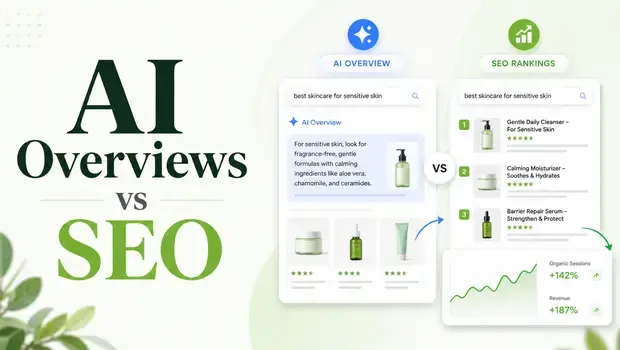
The way shoppers find products is undergoing a massive shift. Instead of scrolling through ten blue links to compare options, consumers are asking complex questions and receiving instant, synthesized answers at the top of their screens.
For growing Shopify stores, this shift introduces a new challenge. Optimizing for traditional search engine algorithms is no longer enough to guarantee visibility. If your store’s content is difficult for large language models (LLMs) to parse, your products will be excluded from these highly visible AI-generated recommendations.
Adapting requires a shift toward Answer Engine Optimization (AEO), ensuring your store is built not just for human shoppers, but for the AI assistants that increasingly guide their purchasing decisions.
Summary
Google AI Overviews are changing how shoppers discover products by providing instant, AI-generated answers above traditional search results. For Shopify stores, ranking now requires Answer Engine Optimization (AEO) structuring content with direct answers, clean formatting, and machine-readable files like llms.txt so AI models can easily discover and cite your products.
What is Google AI Overview
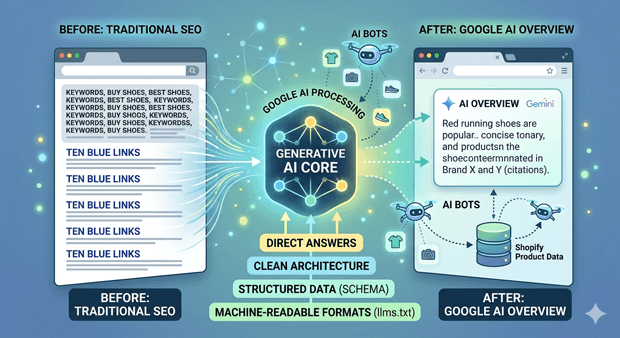
Google AI Overviews summarize search results using generative AI. To appear in these summaries, Shopify stores must shift from keyword density to providing direct answers, clean technical architecture, and machine-readable formats that help AI bots easily understand their products.
How Google AI Overviews Shift Shopify SEO from Clicks to Citations
Google AI Overviews trigger primarily for informational and comparative queries—the exact types of searches shoppers use during the research phase. When a user asks, “What are the best organic skincare routines for dry skin?”, Google’s AI synthesizes information from multiple trusted sources to build a direct response.
If your Shopify blog or product page is cited in this overview, it acts as a high-trust recommendation. If you are excluded, your traditional organic ranking is pushed beneath the AI block, drastically reducing your click-through rate. The goal of modern Shopify SEO is no longer just ranking a page; it is becoming the authoritative source that AI models confidently extract and cite.
Traditional Ecommerce SEO vs Answer Engine Optimization (AEO)
Understanding the gap between standard SEO and AEO is the first step in adapting your store’s architecture. AI models evaluate content differently than legacy web crawlers.
| Feature | Traditional Shopify SEO | AI Overview Optimization (AEO) |
| Primary Goal | Ranking high in organic blue links. | Being cited as a source in AI-generated answers. |
| Content Focus | Keyword density and long-form content. | Direct answers, concise definitions, and high information gain. |
| Technical Priority | Fast load speeds and XML sitemaps. | Clean HTML, semantic heading structures, and llms.txt files. |
| Trust Signals | Backlinks from external websites. | E-E-A-T (Expertise, Experience, Authoritativeness) and original data. |
| Formatting | Flowing paragraphs. | Extractable formats: bulleted lists, comparison tables, and short summaries. |
Why an llms.txt File is Essential for Shopify AI Visibility
An llms.txt file is a plain-text document placed in a website’s root directory that provides a clean, machine-readable map of your most important content. It helps large language models bypass heavy code and easily discover, interpret, and cite your products or educational content.
Modern ecommerce sites are often heavy with JavaScript, dynamic elements, and promotional pop-ups. While traditional Google bots can render this, many AI crawlers struggle to separate your core product information from the surrounding code. By implementing an llms.txt file, you provide AI models with a curated, distraction-free version of your store.
Creating and managing this file manually can be technical. Many Shopify merchants use tools like GP ‑ llms.txt AEO Optimizer to automate the process.
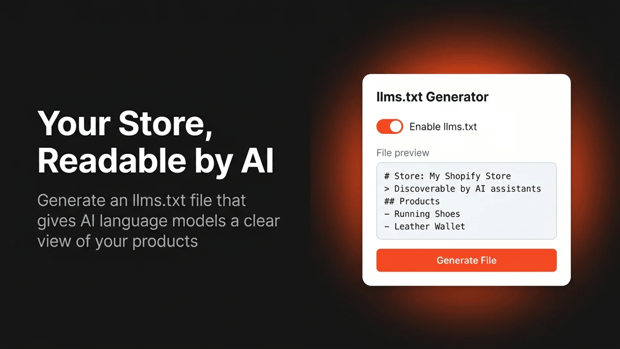
A tool such as GroPulse generates an llms.txt file specifically formatted so AI language models can read and reference your products. It also allows you:
- To control exactly which AI crawlers (from ChatGPT and Gemini to Perplexity) can access your store content.
- Furthermore, it includes a live analytics dashboard to track AI bot visits in real time, lets you add custom brand instructions to guide how AI models discuss your store, and auto-notifies search engines of content updates via IndexNow integration.
How to Optimize Shopify Pages for Google AI and LLMs
To increase the likelihood of your Shopify store being featured in AI Overviews, you must structure your content for easy extraction.
1. Front-Load Direct Answers
Start your blog posts and product category descriptions with a clear, concise answer to the user’s primary question. AI models look for 40-to-60-word summaries that directly resolve a query without needing heavy interpretation.
2. Implement Semantic Heading Structures
Use specific, question-based headings rather than generic terms. An AI model can easily understand a heading like “How to Choose the Right Ring Size” but will struggle to extract exact meaning from a vague heading like “Sizing Guide.”
3. Leverage Structured Data (Schema Markup)
Ensure your Shopify store uses robust structured data. Product schema is standard, but adding FAQ and How-To schema to your educational content gives AI models explicitly labeled data to pull into their overviews.
4. Incorporate Extractable Formats
AI Overviews frequently synthesize data into lists and tables. Format your product comparisons, sizing charts, and step-by-step tutorials using clean HTML tables and bullet points.
What This Means for Shopify Merchants
The Business Impact: Adapting to AI Overviews means shifting resources from generic keyword articles to highly specific, expert-led content. If your store relies heavily on top-of-funnel informational traffic, you must structure your pages to be cited by AI, or risk losing that traffic entirely as zero-click searches increase. Brands that optimize for AI extraction now will establish themselves as the default recommendations in modern AI shopping assistants.
Common Technical Mistakes Blocking AI Bots from Your Store
Even with excellent content, technical barriers can prevent AI from citing your Shopify store.
- Blocking AI Crawlers Accidentally: Check your robots.txt file. If you have broadly blocked generic user agents or failed to manage permissions properly, AI models from OpenAI or Google may not be able to read your site.
- Hiding Content Behind Tabs or Accordions: If crucial product details, shipping policies, or FAQs require a user to click to expand them, some AI crawlers may miss the text entirely. Ensure vital information is present in the raw HTML.
- Publishing Vague, Fluff-Filled Content: AI models synthesize facts. If your product description says, “This is the best shirt ever and will skyrocket your confidence,” an AI bot cannot use that. It needs factual, descriptive data: “Made from 100% organic cotton with double-stitched seams.”
The Complete Shopify AI Overview Readiness Checklist
Use this checklist to ensure your store is prepared for generative search engines:
- Does every informational page start with a concise, direct answer?
- Are generic headings replaced with specific, query-based H2s and H3s?
- Is an llms.txt file present in the root directory to guide AI crawlers?
- Is FAQ and Product schema correctly implemented across the store?
- Are complex topics broken down into bulleted lists or comparison tables?
- Do you have a system (like IndexNow) to immediately notify search engines of content updates?
- Is your content free of unsubstantiated marketing hype, focusing instead on factual information gain?
Frequently Asked Questions About Shopify AEO
How do I track if AI bots are visiting my Shopify store?
Traditional Google Analytics (GA4) tracks human visitors, not necessarily AI crawlers building their datasets. To track AI bots, you need server log analysis or specialized AEO analytics tools that monitor specific user agents like Google-Extended, GPTBot, or PerplexityBot in real time.
Will AI Overviews decrease my Shopify sales?
AI Overviews primarily impact informational, top-of-funnel traffic. High-intent, transactional searches still heavily feature traditional product listings and ads. However, being cited in an AI Overview can increase brand trust and drive highly qualified, pre-educated traffic to your store.
Should I block ChatGPT and Perplexity from scraping my store?
If you want your products recommended by these platforms, you should allow them to crawl your site. Blocking them ensures your brand will be invisible when users ask these AI assistants for shopping recommendations.
Securing Your Store’s Visibility in AI-Driven Search
The integration of generative AI into search engines is not a passing trend; it is a fundamental shift in how information is retrieved and synthesized. For Shopify merchants, the mandate is clear: optimize for the answer, not just the click.
By restructuring your content for clarity, providing machine-readable formats, and focusing on genuine information gain, you can ensure your store remains a trusted, highly visible source in the new era of AI search.