For years, the goal of SEO was simply to rank #1. Today, that’s often not enough. Above the first organic result lies “Position Zero”—the Featured Snippet.
It steals a massive portion of clicks (some studies suggest over 8% of all clicks go to the snippet alone) and establishes immediate authority.
For Shopify merchants, the stakes are even higher. You aren’t just competing with other stores; you’re competing with massive publishers and AI-generated answers.
If your content is a “wall of text” without clear hierarchy, Google’s bots (and the new AI Overview algorithms) cannot extract the answers they need.
The mistake most merchants make is focusing solely on keywords. They stuff “organic cotton t-shirt” into a paragraph five times but fail to structure the page so Google understands what the product is.
Real SEO authority requires a dual approach: Visual Structure (Headings/Lists) for the user and Technical Structure (Schema/JSON-LD) for the bot. This guide covers how to optimize Shopify Content Structure to capture those elusive rich results.
What is Content Structure Optimization?
Content structure optimization is the strategic organization of a webpage using hierarchical HTML tags (H1, H2, H3) and semantic formatting (lists, tables, bolding). It helps search engines parse information efficiently, significantly increasing the likelihood of winning Featured Snippets (Position Zero) and appearing in Google AI Overviews.
Summary:
- Structure Signals Relevance: Google uses heading tags (H1–H6) to understand the logic of your page; flat content rarely wins snippets.
- Match the Format: To win a list snippet, you must code a list. To win a definition snippet, you need a concise 40–50 word paragraph.
- Schema is the Key: Structured data (JSON-LD) acts as a roadmap for crawlers, explicitly defining FAQs, Articles, and Products.
- The “Inverted Pyramid”: Place the most direct answer immediately after the heading question to increase snippet probability.
Why Google Craves Hierarchy (And Why Flat Content Fails)
Googlebot is essentially a speed-reader that relies on signposts. When it scans your Shopify product description or blog post, it looks for a logical outline.
If your page is just bold text and paragraphs without HTML heading tags (<h1>, <h2>, <h3>), Google sees a flat, unstructured blob of data. It doesn’t know where a topic starts or ends.
The Role of Semantic HTML
To optimize for snippets, you must treat your content like a database.
- H1: The Main Topic (Used once per page).
- H2: The Core Subtopics (The main questions users ask).
- H3: Detailed steps or nuances within those subtopics.
When you align your HTML structure with the user’s intent, you make it easy for Google to “lift” a section of your content and display it directly on the search results page.
Designing Your Heading Hierarchy for Snippet Wins
To win a snippet, your heading must often match the user’s search query closely, and the content immediately following it must answer that query directly.
1. The “Trigger” Heading Strategy
Don’t use vague headings like “General Information.” Instead, use specific, entity-rich headings that mirror the questions your customers ask.
- Bad H2: Size Guide
- Good H2: How do I choose the right size for [Brand Name] denim?
The second option contains the entity (Brand Name/Denim) and the action (Choose size), making it a prime candidate for a “How-to” snippet.
2. The “Tenderizer” Paragraph
Immediately after your H2 question, write a “tenderizer”—a direct, concise answer between 40 and 60 words. This is the optimal length for a paragraph snippet.
Expert Tip: Avoid starting this paragraph with fluff like “That is a great question…” Start directly with the answer: “To choose the right size, measure your waist circumference and compare it to our sizing chart below…”
Formatting Content for Specific Snippet Types
Different queries trigger different snippet formats. You cannot win a “List” snippet with a paragraph of text. You must match the format to the intent.
The Paragraph Snippet (Definitions)
- Intent: “What is…”, “Why does…”
- Structure: H2 Question + 40-50 word direct text answer.
- Example: “What is 100% GSM cotton?”
The List Snippet (Processes & Best Of)
- Intent: “How to…”, “Best steps for…”, “Top 10…”
- Structure: H2 Statement + HTML Ordered List (<ol>) or Unordered List (<ul>).
- Strategy: Ensure each list item is concise. Google often truncates long list items.
The Table Snippet (Data & Comparisons)
- Intent: “Prices”, “Sizes”, “Comparison”, “Specs”
- Structure: HTML Table (<table>) with clear headers (<th>).
- Shopify Context: Use this for size charts or “Product A vs. Product B” comparisons.
Accelerating Snippet Wins with Structured Data (Schema)
While visual headings are crucial, Schema Markup (JSON-LD) is the “backend” language that confirms your content structure to Google. It removes the guesswork.
For example, if you have a Frequently Asked Questions section at the bottom of your product page, visual text is good, but FAQ Schema is better. It explicitly tells Google, “Here is a Question, and here is the Answer,” which can result in your FAQs appearing directly in the search results (Rich Snippets).
How to Implement Schema Without Coding
Manually writing JSON-LD code for every product or blog post is error-prone and time-consuming. One missing comma can break the entire code.
Many merchants use the GP JSON-LD Schema for SEO app to automate this.
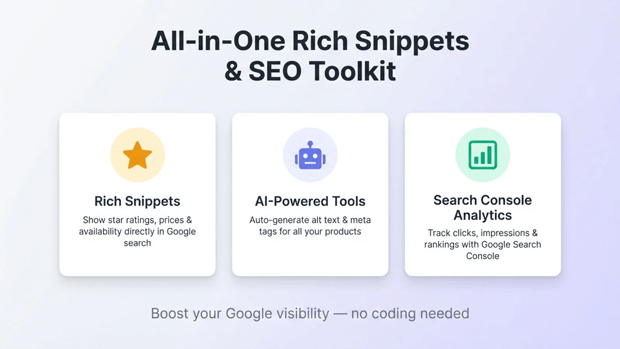
- FAQ Schema: You can enable FAQ schema to mark up your question-and-answer sections, increasing the chance of them appearing as rich results.
- Article Schema: For blog posts, the app ensures Google understands the headline, image, and publish date, which is vital for appearing in Google Discover and News snippets.
- Product Schema: Essential for getting price, availability, and star ratings to show up in search.
By using a tool like this, you ensure the technical hierarchy supports your visual hierarchy. You focus on writing great answers; the app handles the JSON-LD delivery.
Using AI to Find “Low Hanging Fruit” Opportunities
You likely have pages on your site right now that are ranking in positions #4–#10 but haven’t captured the snippet yet. These are your biggest opportunities.
Identifying Underperforming Content
You need to look at your Search Console data. Look for queries where you have high impressions but low clicks—this often indicates you are ranking on Page 1 but losing traffic to the Featured Snippet above you.
GP JSON-LD Schema for SEO includes a Content Optimization feature that connects directly to your Google Search Console.
- It analyzes your performance data to identify content opportunities.
- It provides AI-powered recommendations based on that data.
- It helps you spot “Priority Tasks” to improve your content strategy.
Instead of guessing which H2 needs rewriting, you can use data-driven insights to pinpoint exactly where your structure is weak.
Read More:
👉 AI Meta Tags Generator for Shopify Products Automatically
👉 How to Audit Facebook Ads with AI: The Shopify Merchant’s Guide
👉 How to Diagnose Google Ads Campaign in Shopify Using AdTrack
Common Structural Mistakes That Kill Snippet Chances
Even with good intent, simple formatting errors can disqualify you from Position Zero.
1. Orphaned Headings
Using H4s or H5s without a preceding H2 or H3 confuses the hierarchy. Always follow a logical order (H1 -> H2 -> H3).
2. Using Images for Text
If your “Size Chart” is a JPG image, Google cannot read the data inside it for a Table Snippet. Always use HTML tables for data.
3. Neglecting Meta Tags
While meta tags don’t directly control the snippet content, the Meta Title and Meta Description control the “blue link” result below it. If you win the snippet but your title is unclickable, you lose the traffic.
- GP JSON-LD Schema for SEO allows you to manage Meta Tags for products, collections, and blogs.
- You can use AI suggestions to ensure your titles are punchy and contain the keywords Google expects to see in a high-quality result.
Frequently Asked Questions
Does changing my H2s affect my current ranking?
Yes, usually for the better. Clearer H2s help Google understand your relevance. However, dramatic changes can cause temporary fluctuation. Always monitor Search Console after structural updates.
Can I have multiple H1 tags on a Shopify page?
Technically yes, but it is not recommended. Best practice is to have one single H1 that defines the page’s primary topic, followed by H2s for subtopics.
How long does it take to get a featured snippet?
There is no set time. If you optimize an existing high-ranking page (Page 1), you could see a snippet win in a few days after Google re-crawls the page. For new content, it takes longer to build authority first.
Does Schema guarantee a rich snippet?
No. Google explicitly states that structured data makes you eligible for rich results, but it does not guarantee them. However, without schema, your chances are significantly lower.
Conclusion: Structure is Strategy
Optimizing your content structure isn’t just about “making it look nice.” It is a direct communication line to Google’s algorithms. By aligning your visual hierarchy (Headings) with technical precision (Schema), you turn your Shopify store into an entity that search engines trust and understand.
Start small: Audit your top 5 best-selling product pages. Rewrite the descriptions with clear H2s, add an HTML size table, and ensure your Product and FAQ schemas are active. The path to Position Zero is built one heading at a time.