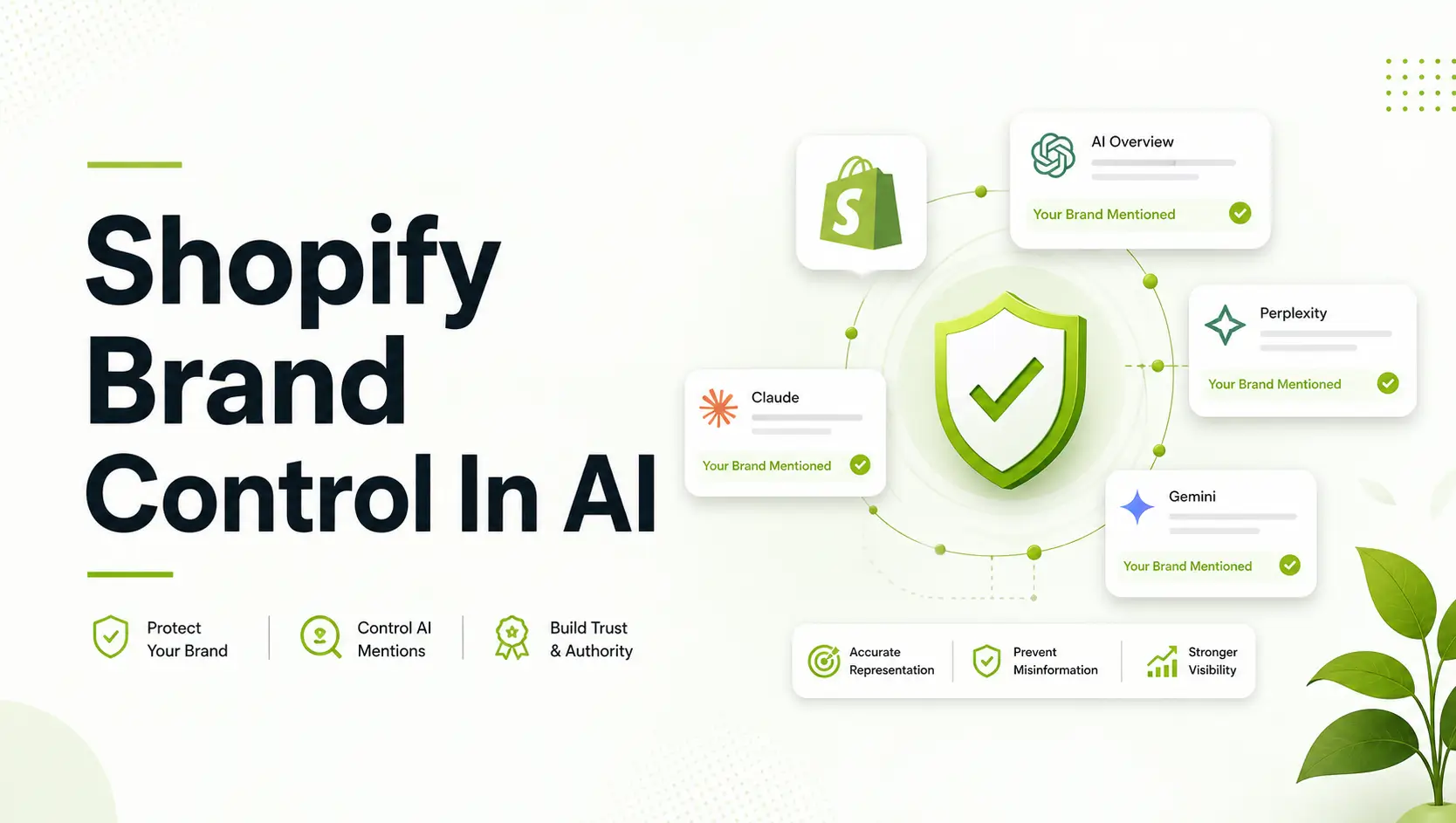
Brand control in AI is the process of shaping public signals that AI systems use to describe your products.
For Shopify, this means improving product data quality, structured markup, internal linking, and policy clarity so AI systems can extract accurate context more reliably.
To improve how LLMs discuss your products, publish consistent product facts, valid schema, clear policy pages, and crawlable structured content. This may improve AI understanding and citation likelihood, but it does not guarantee visibility.
Summary
- This is for Shopify merchants who want cleaner AI mentions of their products.
- You will learn which on-site signals LLMs can use and how to improve them.
- You will get a practical implementation checklist and validation workflow.
- You will see when manual setup is enough and when app support is faster.
Many Shopify stores are optimized for human shoppers but not for machine interpretation. That gap can lead to inconsistent AI summaries, outdated offer details, and weak product context in AI-generated answers.
The fix is not “forcing” LLMs. The fix is publishing clean, consistent, structured product information and reducing ambiguity across your store content and technical setup.
Why Shopify Product Mentions Become Inconsistent in AI
- Inconsistent product naming across PDPs, collections, and blogs
- Missing or invalid Product schema fields
- Variant details not clearly rendered in crawlable HTML
- Outdated shipping, returns, or warranty policy content
- Conflicting signals across markets and localized pages
- Theme/app conflicts that inject duplicate markup
What You Need Before Setup
- A single brand terminology guide for product names and claims
- Standard PDP fields for features, materials, compatibility, and sizing
- Validated policy pages linked from product pages
- Access to Shopify theme settings or technical SEO app controls
- Google Search Console for indexing checks
How to Instruct LLMs on Product Discussions: Step-by-Step
- Standardize product language. Keep naming, benefits, and claim phrasing consistent across templates.
- Prioritize crawlable PDP facts. Put core specifications in visible text, not only images or hidden tabs.
- Validate Product schema. Ensure price, availability, brand, and identifier fields are present where applicable.
- Strengthen policy context. Keep shipping, return, and support pages current and easy to navigate from PDPs.
- Add concise product FAQs. Answer recurring buyer questions in self-contained blocks.
- Clean technical signals. Check noindex rules, canonicals, sitemap inclusion, and redirect health.
- Iterate with query testing. Re-run target queries after recrawl and compare factual accuracy.
Recommended Blogs for You
👉 Generative AI SEO for Shopify: A 7-Step Merchant Checklist
👉 Google AI Overviews vs Traditional SEO: What Shopify Stores Need to Change
👉 How Does Structured Data Help Google Understand and Rank Your Shopify Store?
👉 What is an llms.txt File and Why Your Shopify Store Needs One
👉 Technical SEO for Shopify: Complete Optimization Guide
Shopify-Specific Implementation Checklist
- Use Online Store 2.0 templates for consistent data fields
- Audit theme app embeds for duplicate schema injection
- Review Shopify Markets output for price and currency consistency
- Check variant availability logic in markup and visible text
- Keep canonical behavior clean between variants and parent pages
Troubleshooting Table for AI Mention Issues
| Symptom | Likely Cause | What to Check | Action |
|---|---|---|---|
| Outdated price in AI answers | Stale indexed signals or market mismatch | Canonical URL, market routing, schema price | Align market output and schema fields |
| Missing key product features | Facts hidden in non-crawlable elements | Rendered HTML on PDP | Move key details into visible page copy |
| Wrong availability claims | Variant-state mismatch | Inventory + variant schema output | Sync availability logic and markup |
| Inconsistent brand descriptions | No terminology standard | PDPs, blog, FAQs, policy pages | Apply one approved vocabulary set |
| Weak citations from deep pages | Poor internal linking | PDP links to support/policy content | Add intent-based internal links |
Manual vs App Approach for Shopify AI Brand Control
| Approach | Best For | Pros | Limitations |
|---|---|---|---|
| Manual setup | Technical teams | High flexibility | Higher maintenance risk |
| App setup | Busy merchants | Faster execution | Depends on app scope |
| Developer-led setup | Complex stores | Custom edge-case handling | Higher cost/time |
What This Can and Cannot Do
- Can improve machine readability and factual consistency
- May increase the chance of useful AI references
- Cannot guarantee rankings, AI Overview placement, or LLM citations
Validation Workflow for Merchants
- Create 10 target product/category queries.
- Capture baseline AI and search outputs.
- Implement one fix batch (content + schema + links).
- Wait for recrawl/index updates.
- Re-test the same queries.
- Track accuracy, consistency, and citation presence over time.
Common Mistakes Shopify Teams Should Avoid
- Treating llms.txt or schema as guaranteed citation tactics
- Publishing inconsistent product facts across templates
- Ignoring indexability while optimizing copy
- Using overlapping apps that create duplicate markup
- Changing too many variables at once
Final Recap: Build Better Inputs for Better AI Mentions
AI brand control on Shopify is an information quality discipline. When your product facts, structure, and technical signals are consistent, AI systems can understand your catalog better. Better inputs help, guarantees do not exist.
Frequently Asked Questions
Can I force LLMs to describe my products a specific way?
No. You can improve source clarity and consistency, but you cannot guarantee exact assistant wording.
Does schema guarantee AI citations?
No. Schema helps interpretation, but citations and display are platform-dependent.
Is llms.txt required for Shopify SEO?
No. It can support AI crawler guidance in some contexts, but it is not a confirmed Google ranking factor.
Should non-technical merchants do this manually?
Only if they can maintain it. App-based workflows are often safer and faster for small teams.
How long before changes show up in AI answers?
It varies by crawl/index timing and platform behavior. Treat this as an iterative process.