Customer acquisition costs (CAC) on paid advertising platforms have skyrocketed in recent years. For many Shopify merchants, relying solely on Facebook, TikTok, or Google Ads to drive sales results in razor-thin profit margins—or worse, a store that loses money on every first-time purchase.
The good news is that paid ads are an accelerant, not a requirement. Building a profitable ecommerce business without them is entirely possible if you shift your focus from buying traffic to building sustainable revenue pillars.
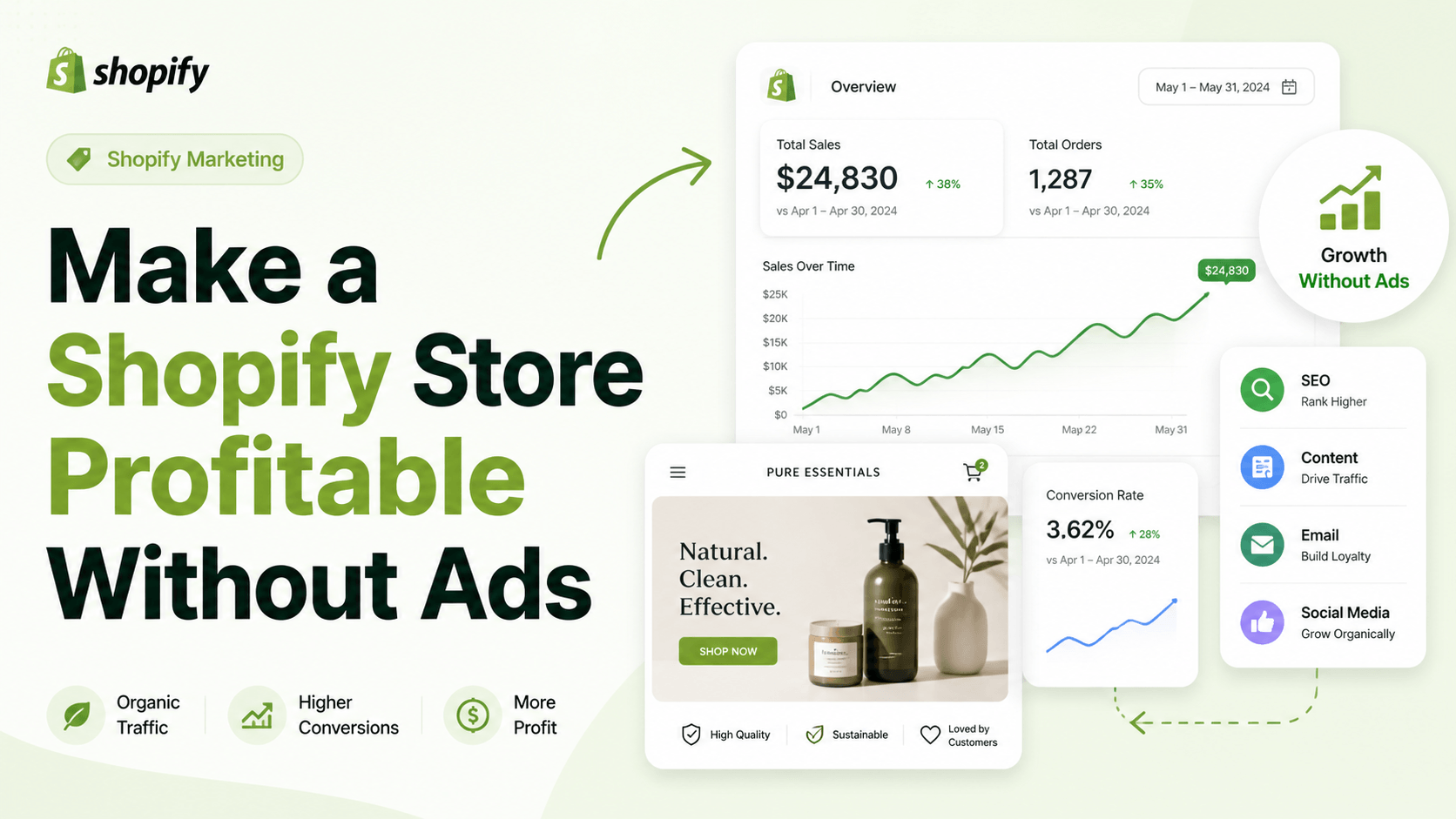
In this guide, we will break down exactly how to make a Shopify store profitable without ads by optimizing four key areas: Organic Traffic (including traditional SEO and AI Search), Conversion Rate, Average Order Value (AOV), and Customer Lifetime Value (LTV).
To make a Shopify store profitable without ads, focus on four pillars: driving organic traffic through SEO, optimizing your conversion rate, increasing Average Order Value via product bundling, and maximizing Customer Lifetime Value through email retention.
Step 1: Drive Free Organic Traffic Through E-commerce SEO
If you aren’t paying for traffic, you need to earn it. Search Engine Optimization (SEO) is the most reliable way to bring high-intent shoppers to your Shopify store without spending a dime on clicks.
Optimize Product and Collection Pages
Do not rely on manufacturer descriptions. Write unique, comprehensive product descriptions that naturally include the keywords your customers are searching for. Pay special attention to your Collection pages, as these often act as the primary landing pages for broad organic searches.
- Actionable step: Ensure every page has a properly optimized meta title, meta description, and H1 tag.
Implement Structured Data (Rich Snippets)
Rich snippets allow your products to stand out in Google Search results by displaying prices, review stars, and availability directly in the search page. This drastically increases organic click-through rates.
- How to do it: Shopify themes include basic schema, but to fully optimize for Google AI Overviews and rich results, tools like GroPulse JSON-LD Schema automatically generate comprehensive schema.org markup for products, FAQs, and breadcrumbs without requiring custom theme code.
Optimize for AI Search Engines (AEO)
Traditional Google searches aren’t the only way people find products anymore. Shoppers are increasingly asking AI assistants like ChatGPT, Perplexity, and Claude for product recommendations. If your store isn’t formatted for AI language models to read, you are missing out on a massive new source of free traffic.
- What this means for Shopify merchants: Just as you use an XML sitemap for Google, you should use an llms.txt file—a new machine-readable format specifically designed to help AI models digest your store’s content, brand guidelines, and product details.
- How to do it: You don’t need a developer to build this. Tools like the GP ‑ llms.txt AEO Optimizer automatically generate and manage this file for your Shopify store. It allows you to control exactly which AI crawlers can access your content, feed custom brand instructions directly to the AI, and track which AI bots are actively visiting your store through a live analytics dashboard.
Step 2: Optimize Conversion Rates (CRO) to Capitalize on Existing Traffic
When your traffic is limited to organic sources, you cannot afford to waste it. Conversion Rate Optimization (CRO) ensures that the highest possible percentage of your visitors actually complete a purchase.
Build Unshakable Trust
Shoppers will not buy from an unknown organic store if it feels risky.
- Display real customer reviews with photos.
- Include clear shipping and return policies on product pages.
- Offer secure, familiar payment gateways (Shop Pay, PayPal, Apple Pay).
Simplify the Checkout Journey
Every extra click between the product page and the final checkout reduces your conversion rate. Enable sticky “Add to Cart” buttons and consider implementing a slide-out cart drawer so users can review their order without being redirected away from the shopping experience.
Step 3: Increase Average Order Value (AOV) to Maximize Profit Margins
Profitability isn’t just about how many orders you get; it’s about how much revenue you generate per order. Increasing your Average Order Value is the fastest way to boost your store’s profitability without needing a single extra visitor.
Use Product Bundling
Bundling allows you to sell multiple items together at a slight perceived discount, instantly raising the order value.
- What this means for Shopify merchants: Instead of selling one $20 item, you sell a “Starter Kit” for $50. The slight discount is offset by the massive increase in gross profit per transaction. Tools like GP Bundle Builder allow merchants to easily create mix-and-match, tiered, or “build-your-own” bundles using native Shopify discount functions, making this strategy effortless to deploy.
Gamify the Free Shipping Threshold
Customers hate paying for shipping, but they love “unlocking” it. Calculate your current AOV, and set your free shipping threshold 15% to 20% higher than that number.
- Pro Tip: Use an app like the GroPulse Free Shipping Bar to display a dynamic progress bar at the top of your site or in the cart drawer (e.g., “You are $12 away from Free Shipping!”). This visual cue is a proven psychological trigger that encourages shoppers to add one more item to their cart.
Offer Post-Purchase Upsells and Gift Options
Don’t stop selling just because the item is in the cart. Offering simple upsells—like premium packaging or personalized messages—adds pure profit to the order. For example, allowing customers to add a paid gift box or ribbon directly on the product page captures extra margin with zero additional marketing cost.
Step 4: Maximize Customer Lifetime Value (LTV) via Retention
A profitable ad-free store relies heavily on repeat purchasers. It costs significantly less to retain an existing customer than to acquire a new one organically.
Automate Email Marketing Flows
Set up robust email automation to capture revenue that would otherwise be lost:
- Welcome Series: Offer a small discount in exchange for an email address.
- Abandoned Cart: Remind shoppers of what they left behind (send 2-3 emails).
- Post-Purchase Nurture: Thank the customer, provide usage tips for the product, and eventually pitch a complementary item.
- Win-Back Campaigns: Target customers who haven’t purchased in 60, 90, or 120 days.
Launch a Loyalty Program
Incentivize repeat purchases by offering points for every dollar spent, social media follows, and birthday rewards. VIP tiers make your best customers feel valued and encourage them to consolidate their category spending with your store.
Common Mistakes When Bootstrapping a Shopify Store
If you are trying to grow organically, avoid these conversion killers:
- Ignoring email capture: If you don’t capture a visitor’s email, and they leave without buying, they are gone forever. Always use an exit-intent popup.
- Selling low-margin products: Organic growth is slow. If your profit margin is only $5 per item, it is incredibly difficult to build a sustainable business. Aim for products with at least a 50% gross margin.
- Relying purely on social media algorithms: An algorithm change can wipe out your traffic overnight. Always funnel social media followers to your owned email and SMS lists.
The Organic Profitability Checklist for Shopify Merchants
| Focus Area | Action Item | Priority |
| Traffic | Optimize Product/Collection meta titles and H1s | High |
| Traffic | Implement JSON-LD structured data for rich snippets | High |
| Traffic | Generate an llms.txt file to make products visible to AI engines like ChatGPT | High |
| CRO | Ensure mobile page load speed is under 3 seconds | High |
| AOV | Create a product bundle or “frequently bought together” offer | High |
| AOV | Add a dynamic free shipping progress bar | Medium |
| Retention | Activate a 3-part abandoned cart email sequence | High |
| Retention | Set up an automated post-purchase review request | Medium |
Original Insight to Add
Proposed Data: “The Ad-Free AOV Benchmark Report”
What to collect: Aggregate anonymized data from Shopify stores using GroPulse apps (specifically Bundle Builder and Free Shipping Bar) that spend less than $500/month on paid ads.
How to collect it: Analyze the percentage increase in AOV and Gross Profit Margin for these stores 90 days after implementing bundling and dynamic shipping bars compared to their baseline.
Why it adds value: It provides a proprietary, factual benchmark proving exactly how much organic revenue can be salvaged through site merchandising, giving readers a realistic expectation of ROI when shifting away from ad spend.
Frequently Asked Questions
Can a Shopify store survive without ads?
Yes. A Shopify store can thrive without ads by focusing on organic search engine optimization (SEO), content marketing, email list building, and optimizing the site for high Average Order Value (AOV) and repeat purchases.
How long does it take to get organic traffic on Shopify?
With consistent SEO efforts, it typically takes 3 to 6 months to start seeing meaningful organic traffic from Google. This timeline depends on your niche competitiveness, keyword strategy, and the quality of your site’s content and technical SEO.
What is a good profit margin for a Shopify store?
A healthy gross profit margin for an ecommerce store is generally between 40% and 60%. Net profit margins (after all operating expenses) typically range from 10% to 20% for a healthy, established store.
How can I increase my Shopify AOV organically?
You can increase AOV without ad spend by implementing product bundling, setting a strategic free shipping threshold using a progress bar, offering post-purchase upsells, and providing premium add-ons like gift wrapping.
Does SEO actually work for dropshipping stores?
Yes, but it requires effort. Because dropshippers often sell the same products as competitors, you must write highly unique product descriptions, build informative blog content around your niche, and optimize your collection pages to stand out in search results.