Gifting drives a huge share of DTC revenue, especially during peak seasons like Q4, Valentine’s Day, and Mother’s Day. Yet, many Shopify merchants struggle with a fundamental pricing question: should gift wrap be a free perk, a discounted add-on, or a premium paid service?
Guessing the answer costs merchants money. If you give premium packaging away for free, you eat the margin. If you charge too much without justification, you miss out on potential upsells and frustrate gift-giving shoppers.
The solution lies in your Shopify gift wrap analytics. By measuring how your customers interact with gifting options, you can deploy a pricing strategy that protects your margins while delivering a flawless unboxing experience.
To decide whether to charge or offer free gift wrap on Shopify, track your gift wrap attach rate and profit margins. Offer free wrap to boost baseline conversions, or charge for premium wrap options (like boxes and ribbons) to increase Average Order Value (AOV).
Summary
- The core decision: Offering free gift wrap drives conversion, while charging for premium wrap increases Average Order Value (AOV).
- Data is key: You cannot optimize what you do not measure. Tracking attach rates and per-option revenue is critical for finalizing your strategy.
- Native tracking wins: Using actual Shopify product variants for gift wrap ensures your revenue data stays accurate within your standard Shopify reporting.
- App solutions: Dedicated tools can provide daily analytics roll-ups, showing exactly which wrap options are selling and how much incremental revenue is generated.
What the Shopify Gift Wrap Decision Looks Like in Real Life
Imagine a growing Shopify boutique selling candles and home goods. Gifting makes up 20–60% of their revenue during the holidays.
Initially, the store offers a manual “add a note at checkout” field and wraps everything for free. The fulfillment team is overwhelmed guessing which orders actually need wrapping, and the business absorbs the cost of premium paper and boxes.
The merchant realizes they are leaving money on the table. They need to transition to a tiered model: basic items might get a simple free wrap, but premium velvet boxes or linen bags should be a paid upsell. To do this safely without hurting conversion rates, they need data.
Why Merchants Need a Data-Driven Gifting Strategy
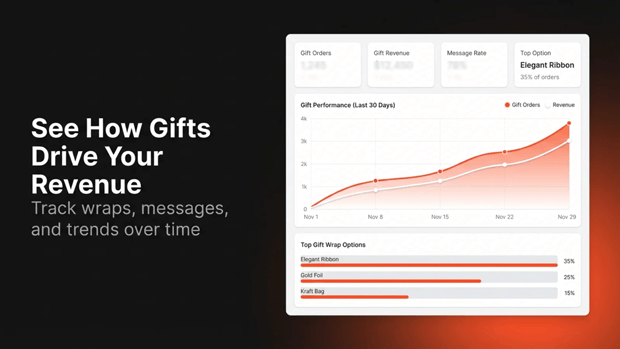
Without clear analytics, a gift wrap program operates in the dark. Shoppers have strict expectations when buying gifts: they want it wrapped nicely (and are often willing to pay for it), they want to include a personal message, and they do not want the recipient to see the price.
When you fail to meet these needs, you lose the initial upsell revenue and risk customer support tickets asking to hide invoices. Tracking your gifting metrics allows you to:
- Protect margins: Ensure your paid options cover the cost of materials and the extra fulfillment labor.
- Optimize inventory: Know exactly whether shoppers prefer $3 kraft paper, $6 linen, or $9 velvet boxes.
- Increase attach rates: Test different price points to see which generates the highest percentage of adoption at checkout.
Recommended Blogs for You:
👉 How to Add Paid Gift Wrap to Shopify and Increase Q4 AOV
👉 How to Manage Corporate Gifting on Shopify
👉 How to Offer Personalized Gift Messages on Shopify
👉 How to Make a Shopify Store Profitable Without Ads
Step-by-Step: Analyzing Shopify Gift Wrap Performance
To make an informed decision on pricing, you need to track specific KPIs. Here is the workflow for dialing in your strategy.
1. Establish Your Baseline Attach Rate
Your attach rate is the percentage of total orders that include gift wrap. If you currently offer free wrap, this number will be your ceiling. If you introduce a fee, monitor how much this rate drops. A slight drop is acceptable if the new revenue outweighs the lost volume.
2. Analyze Per-Option Breakdowns
If you offer multiple choices—such as paper, boxes, bags, or ribbons—you need a per-option breakdown to see which is actually selling. If a $12 luxury box has a low attach rate but high margins, it might still be worth keeping as a premium anchor.
3. Monitor Gift Message vs. Gift Wrap Volume
Some shoppers only want a free gift message and a price-free receipt, not physical wrap. Track the volume of “message only” orders versus “paid wrap” orders to understand the true intent of your buyers.
4. Review Total Gift Wrap Revenue
Calculate your total gift wrap revenue and your per-day revenue. Compare this against your material costs to find your break-even point and actual profit.
Hypothetical Shopify Pricing Scenarios
Based on merchant data, here are three common ways to structure your pricing:
- The Free Tier (Conversion Driver): Best for high-margin luxury stores where the unboxing experience is mandatory. You can easily offer free gift wrap by setting the price of the wrap option to $0.
- The Paid Upsell (AOV Booster): Best for stores with items in the under $150 AOV sweet spot. A shopper buying a $45 necklace will readily add a $5 gift box.
- The Tiered Approach (Hybrid): Offer a free basic gift receipt and message, but charge for premium ribbons, paper, or boxes.
Common Roadblocks in Gift Wrap Analytics
The biggest mistake merchants make is treating gift wrap as an opaque app fee or a hidden cart attribute. When wrap revenue doesn’t flow into standard Shopify reports, it becomes nearly impossible to track profitability.
Furthermore, if your store only offers gift options on the cart page, you may be artificially depressing your attach rate. Shoppers often bypass the cart entirely. Offering gift wrap across the product page, cart drawer, and checkout maximizes visibility.
Tools That Make Gift Wrap Tracking Easier
While you can technically hack together a gift wrap system using theme code and hidden products, doing so makes tracking analytics a nightmare. This is where purpose-built Shopify apps change the workflow.
Using an app designed specifically for this allows you to map each wrap option to a real Shopify product variant, meaning the wrap revenue flows seamlessly through your native Shopify reporting.
If you want to track your gifting metrics without wrestling with spreadsheets or custom theme code, GP — Gift Wrap & Message simplifies the entire process.
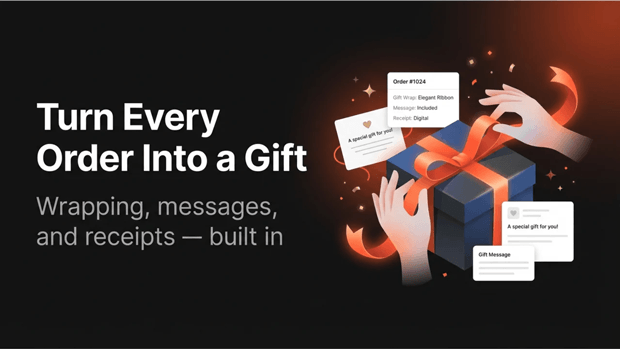
It adds a built-in analytics dashboard that provides daily roll-ups of your attach rate, gift wrap revenue, and per-option breakdowns.
Because every wrap option maps to a real Shopify product variant, your revenue tracking stays perfectly synced with your native Shopify reports. You can install GP — Gift Wrap & Message directly from the Shopify App Store to start capturing the gifting revenue you’re already losing.
What to Do After Dialing In Your Gift Wrap Pricing
Once you know your optimal price point, operationalize it. Ensure your fulfillment team isn’t left guessing. Implement a system where every gift order is auto-tagged with labels like gift-order, gift-wrapped, or has-gift-message so your pick-and-pack team knows exactly what to do.
Freequently Asked Questions
How do I track gift wrap revenue in Shopify?
The most accurate way to track gift wrap revenue in Shopify is to set up your gift wrap options as actual product variants. This ensures all wrap fees are recorded as standard product sales in your native Shopify Analytics reports.
Should I charge for gift wrapping on my Shopify store?
If your average order value (AOV) is under $150 and your products are highly giftable, charging a small premium for high-quality wrap is a standard practice that boosts revenue without hurting conversions.
Can I offer free gift wrap but still track the analytics?
Yes. You can create a gift wrap option and set the price to zero. This allows you to track the attach rate—how many people select the free wrap—without charging the customer.
How do I know which gift wrap option is the most popular?
You need a per-option analytics breakdown. By reviewing which specific variants (e.g., paper vs. box vs. ribbon) are added to carts most frequently, you can optimize your packaging inventory.
Does offering a gift message increase conversions?
Yes, giving shoppers the ability to add a personalized note fulfills a core emotional need for gift-givers. It removes friction from the buying process and reduces the likelihood of cart abandonment.